
Data logging · Weather monitoring
Why two identical sensors do not read the same: choosing a radiation shield
The shield around the sensor can contribute more error than the sensor itself. What two peer-reviewed studies say about natural ventilation and forced aspiration, and what to document so the series is usable.
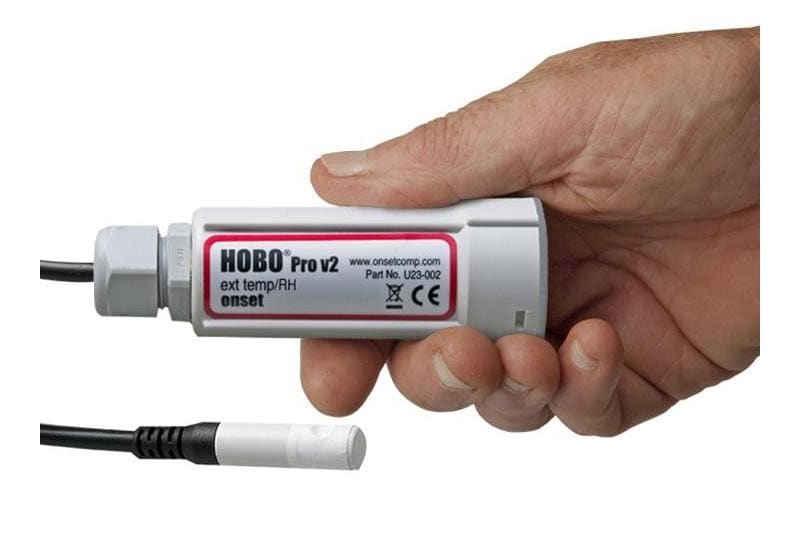
The datasheet promises an accuracy of 0.21 degrees. The logger goes up in the open air, a September afternoon arrives with high sun and light wind, and suppose the series reads half a degree above the official station two hundred metres away. The sensor is not faulty and the datasheet is not lying. What decides that difference is the part sitting between the air and the sensing element: the radiation shield.
A shield has two jobs that work against each other. Block the sun, so the sensor does not read radiation instead of air, and let air move through, so that what is inside matches what is outside. The tighter it is, the better it blocks and the worse it ventilates. This is a decision taken once, when the measurement point is built, and it shapes every reading that follows. It is worth taking with numbers in hand.
Why the shield can outweigh the sensor
A study published in 2026 in the journal Atmosphere compared the Model 41003 shield against a reference instrument in the field. For that shield the paper reports "a maximum experimental radiation error of approximately 1.5 °C and a mean radiation error of 0.59 °C". The trials covered conditions where "wind speed ranged approximately from 0.3 to 3.8 m/s and solar radiation from about 165 to 1000 W/m2".
The mean error that trial attributes to the Model 41003, 0.59 °C, is close to three times the ±0.21 °C accuracy quoted on the datasheet of the U23-002 logger in the catalogue. These are two figures of different origin, set side by side only to give the problem a scale: the shield is no minor accessory next to the sensing element it encloses. Anyone comparing sensors by tenths while ignoring the shield is optimising the small part.
Natural ventilation or forced aspiration
The other useful reference is a long, publicly documented intercomparison. At De Bilt in the Netherlands, "temperatures of ten thermometer screens have been studied for particular weather conditions during a 6-year field experiment", with all ten screens on the same site. Three findings steer the decision.
First, in the clear-sky episode the authors analyse in detail, large naturally ventilated Stevenson screens warm up during the day more than multi-plate ones: the difference around the daily maximum "amounts to about 0.4 °C for this particular situation". That is one dated situation the authors identify, not a constant that can be subtracted from any series.
Second, forced aspiration is not free: it pulls the reading down relative to the reference. "In the presented examples, Young.aspII can easily be 0.5-0.8 °C cooler during the day than Knmi.ref". A fan solves the radiation error and introduces in exchange a dependence on power, a current draw and a moving part that can stop without warning. At a remote, battery-powered point, that moving part is often the link that fails.
Third, wind governs the outcome. The authors put it plainly: "the magnitude of u determines to a large extent the differences in response times between the screens, the magnitude of radiation errors". For global radiation above 750 watts per square metre and the lowest quartile of wind speed, "ΔT ranges between −0.536 °C for Young.apsII and 0.174 °C for Stev.pvc". The worst case is not the scorching day: it is the scorching, still day.
A practical rule follows. If the site is habitually windy and the campaign runs for months, a well-sized multi-plate shield covers most cases. If the hours of calm under high sun are precisely what matters, or if the series will be compared with an official station, either accept aspiration and the maintenance it brings, or accept and document a known daytime bias.
What these studies do not say
Neither of them tested the products listed at the foot of this page. The figures describe the models each team mounted, not a catalogue, and they do not transfer to another shield on the strength of a similar shape.
The 2026 paper is written by authors proposing a design of their own, so the compared shield is the benchmark rather than the subject of the work. Its limits are stated: "the CFD evaluations were mainly conducted under steady-state boundary conditions and did not explicitly quantify the effects of diurnal thermal transients or component aging/soiling on measurement errors". Ageing and soiling of the plates, which arrive quickly in an olive grove or beside a road, fall outside it.
The De Bilt values belong to a maritime climate in northern Europe and to specific situations the authors identify one by one. They are not a correction that can be subtracted from a series measured on the Iberian plateau or in a Mediterranean valley.
And there is the conclusion most worth keeping, because it is the one that changes working practice: "it is not possible to design one particular screen as a worldwide reference".
What to document, since there is no universal reference
If no shield is the reference, the comparability of a series is not inherited from the equipment: it is built in writing. Record the following alongside the data, not in the memory of whoever installed it:
- Shield model and sensor model, with the date of installation.
- Height above ground and the nature of the surface underneath, because reflected radiation enters from below.
- Whether aspiration is fitted, whether it runs continuously and how it is powered.
- The logging interval, which determines how many of those calm hours are captured at all.
- The date of every shield replacement, even for the same model. Swapping a part is swapping an instrument.
Checklist before installing
- Confirm on the datasheet that the specific sensor is compatible with the chosen shield. Compatibility is declared by part number, not by diameter.
- Look at what lies beneath the measurement point. Over pale gravel, concrete or water, the light coming up matters, and many multi-plate shields warn on their own datasheet that they do not cover that angle.
- Decide whether the campaign tolerates a moving part, before buying one.
- Record the model in the series metadata on the day of installation.
- If the series will be compared with an official station, find out which shield that station uses before interpreting the difference.
References
- Jin, W., Zhou, Y., Tang, J. and Amdadul, H.M. (2026). "Design and Experimental Validation of a High-Accuracy Naturally Ventilated Radiation Shield for Near-Surface Air Temperature Observation". Atmosphere, 17(3), 272. DOI 10.3390/atmos17030272. Full text. Accessed 14 September 2026.
- van der Meulen, J.P. and Brandsma, T. (2008). "Thermometer screen intercomparison in De Bilt (The Netherlands), Part I: Understanding the weather-dependent temperature differences". International Journal of Climatology, 28(3), 371-387. DOI 10.1002/joc.1531. Full text in the KNMI repository. Accessed 14 September 2026.
Commercial selection by EIC Controls
The HOBO U23 Pro v2 logger with an external probe measures air temperature and relative humidity, with an accuracy of ±0.21 °C between 0 and 50 °C and a resolution of 0.02 °C at 25 °C according to its datasheet, and a stated drift below 0.1 °C per year. For a series in the open air that probe has to sit inside a shield: the RS3-B is a solar radiation shield whose datasheet declares compatibility with the external sensors of the U23-00X series, and which warns that it does not shield against light reflected from below at some angles, pointing to other models from the same brand for those cases. What remains to be sized in each case is the mounting height, the surface beneath the measurement point and the logging interval.
View the logger datasheet · View the shield datasheet · Talk to a specialist
Instruments for this application
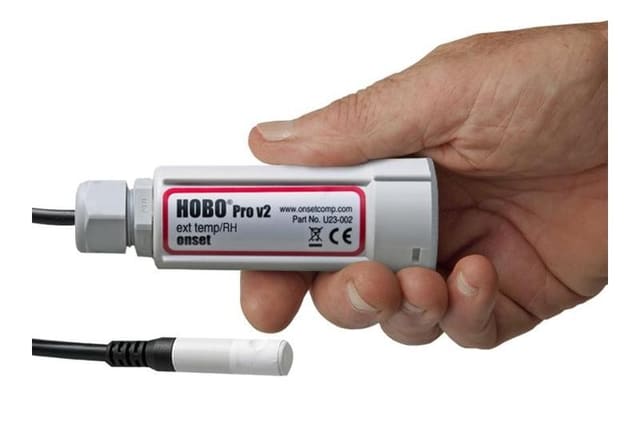
LI-COR (HOBO, InTemp, LI-COR) · U23-002
HOBO U23 Pro v2 External Temperature/Relative Humidity Data Logger
The HOBO Pro v2 External Temperature/Relative Humidity Data Logger is a weatherproof data logger with an external Temperature and Relative Humidity sensor on a 6-foot cable for fast sensor response and deployment in tight spaces. The Relative Humidity sensor…
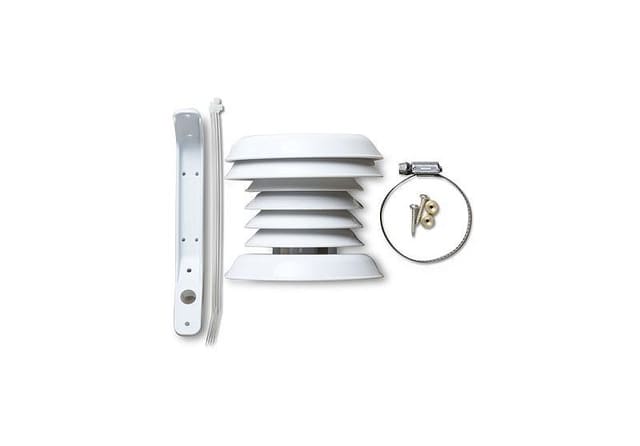
LI-COR (HOBO, InTemp, LI-COR) · RS3-B
Solar Radiation Shield
Use the RS3-B Solar Radiation Shield with HOBO external sensors for improved temperature measurement accuracy in locations exposed to sunlight. The small size and unobstructed airflow of this shield provides a faster response to changing conditions than…
Keep reading
Week in review, 14 to 18 September 2026: your own point, the satellite and the laboratory curve
Three articles on what makes a number measured at one point trustworthy, three European signals from the week with their sources, and what is due in the coming days.
Sentinel-3C is in orbit: what a satellite measures and what your station still measures
On 15 September 2026 the European Union launched Copernicus Sentinel-3C. What it observes from 800 km, why land surface temperature is not air temperature, and what to log at your own point.
Summer 2026 was western Europe's warmest on record: what changes at your measurement point
Copernicus issued its August assessment statement on 10 September 2026: a record summer in western Europe, with anomalies referenced to 1991 to 2020. What those figures say, and do not say, about a series of your own.