
Field calibration or laboratory curve: what one study measured with soil moisture sensors
A study published in May 2026 calibrated low-cost capacitive sensors in the laboratory and then moved them to real plots. The laboratory curve drifted in the field, and a single reference measurement on site recovered much of the accuracy.
The curve that turns a signal into water
A soil moisture sensor does not measure water. It measures an electrical property of the surrounding medium and converts it into volumetric water content through a calibration curve. Anyone deciding on irrigation from that number is trusting a curve they never see. Hence a question that comes up in almost every installation: does the calibration supplied with the instrument, or the one obtained in a controlled test, hold as it is in the field, or must it be rebuilt where the sensor will actually live?
The study's question
A paper published on 22 May 2026 in the journal Sensors, by Glenn Strypsteen, Magnus Persson, Mykola Miroshnychenko and Nikola Rakonjac, asked exactly that: whether calibrations obtained in the laboratory transfer reliably to field conditions, and which calibration strategy is both effective and practical for people working outside a laboratory.
Method
The authors calibrated low-cost capacitive sensors in the laboratory (the Capacitive Soil Moisture Sensor v2.0, read through an Arduino microcontroller) across eight soil types, among them clay loam, loamy sand and silty clay loam. They then installed the same sensors in real plots: two sites in southern Sweden, one uncropped and one with irrigated rapeseed; a garlic plot measured between 21 May and 18 June 2025; and two experiments in Ukraine, one in the dry year of 2024 and one in 2025.
As a reference they used handheld probes (WET and ThetaProbe ML3, from Delta-T Devices) and soil samples oven-dried at 105 °C. On that basis they compared four ways of calibrating: a soil-specific curve obtained in the laboratory, a single curve pooling all eight soils, a calibration built from reference measurements taken in the field itself, and a simplified version of the latter resting on one single reference measurement.
What was observed
In the laboratory the sensors behaved well. The pooled curve applied to the eight soils gave a root mean square error (RMSE) of 0.028 m³/m³ and an R² of 0.93, and the soil-specific curves were closer still.
In the field the ranking reversed. The soil-specific calibration obtained in the laboratory, the most accurate one on the bench, generally drifted furthest once the sensor was buried: between 0.055 and 0.191 m³/m³ RMSE. The calibration built from reference measurements in the field itself was the best of the set, between 0.005 and 0.036 m³/m³. And the simplified version, resting on a single reference point, came second in most of the tests, between 0.006 and 0.078 m³/m³.
In practical terms: in this study, one single reference reading taken where the sensor sits recovered much of the accuracy the laboratory curve lost on moving outdoors. The authors attribute that gap to what changes between the laboratory vessel and the ground, namely bulk density, soil structure and the sensor installation itself.
The work also marks out two boundaries. The first is range: reliable readings ran out at around 0.25 to 0.30 m³/m³, and because of that ceiling the authors conclude the sensor is best suited to soils with less than 35% clay. The second is salinity, measured as the electrical conductivity of the saturation extract: in non-saline soils, with that indicator below 2 dS/m, the pooled curve gave an R² of 0.96 and an RMSE of 0.017 m³/m³, whereas between 2 and 4 dS/m the result fell to an R² of 0.80 and an RMSE of 0.043 m³/m³.
What it does not license
This is a single study and it is worth reading for what it is. The sensors tested are low-cost capacitive units read by a microcontroller, not professional-grade field instruments: the error figures quoted describe that specific hardware and do not carry over to another sensor. The sites are in southern Sweden and Ukraine, with rapeseed, garlic and one uncropped plot; neither the climate, nor the soils, nor the irrigation calendars match those of the Iberian Peninsula.
The authors themselves bound the scope. Texture was the only soil property consistently documented for all soils, and others, such as bulk density, organic matter or porosity, may influence sensor response. Bulk density around the field-installed sensors was not measured. The salinity test used sodium chloride solutions only, a simpler case than the real ionic composition of a soil solution. And the probes used as a reference are not free of uncertainty either.
None of this invalidates the result. It places it: in this study, and with this hardware, calibrating in the laboratory was not enough.
What changes in a measurement decision
The first point is to treat the supplied curve as a starting point rather than a result. If the series is going to drive irrigation decisions, it is worth budgeting from the outset for at least one site visit with a reference instrument, rather than discovering a year later that the series describes the shape of the cycles well but not the absolute value.
The second is to document the soil and the installation. Texture, bulk density and how the sensor ended up seated are precisely the variables the authors flag as the likely source of the laboratory-to-field gap. Without that record, an odd reading twelve months from now can be neither interpreted nor corrected.
The third is to watch electrical conductivity at the same point. It is the condition this study shows degrading the calibration, and it is cheap to follow when the sensor already reports it alongside water content. One caveat on scales: what a buried probe reports is the conductivity of the bulk of soil, water and air around it, which is not equivalent to the saturation extract value on which the study sets its thresholds. It serves to follow the trend at that point, not to place the soil in the article's bands, which require the corresponding analysis.
The fourth is to check where the instrument's ceiling lies before installing it. If the soil is clayey and irrigation pushes water content above the range in which the sensor responds, the series will flatten out in exactly the episodes most worth observing.
The framing bears repeating: this is what was observed in this study, in these soils and with these sensors. It is not a general rule of the discipline. But the question it raises is general, and anyone can answer it on their own plot with a reference measurement.
References
- Strypsteen, G.; Persson, M.; Miroshnychenko, M.; Rakonjac, N. (2026). Field Performance and Calibration Strategies for Low-Cost Capacitive Soil Moisture Sensors. Sensors, 26(11), 3291. https://doi.org/10.3390/s26113291. Accessed 16 September 2026.
- Crossref (2026). Metadata record for DOI 10.3390/s26113291 (no correction or retraction markers at the date of access). https://api.crossref.org/works/10.3390/s26113291. Accessed 16 September 2026.
Commercial selection by EIC Controls
The HOBO MX Soil EC/VWC/Temp Data Logger measures volumetric water content, electrical conductivity and soil temperature at a single point and stores the series on its own. That combination is relevant here because electrical conductivity is one of the conditions the study identifies as limiting the calibration, and having it alongside water content allows the trend at that point to be followed, without that reading being equivalent to the article's saturation extract. For reference readings on site, the FieldScout TDR 350 Soil Moisture Meter with Case takes spot measurements of volumetric water content using time-domain technique. Depth and number of measurement points, installation accessories and the way data are retrieved still need to be sized case by case.
Instruments for this application
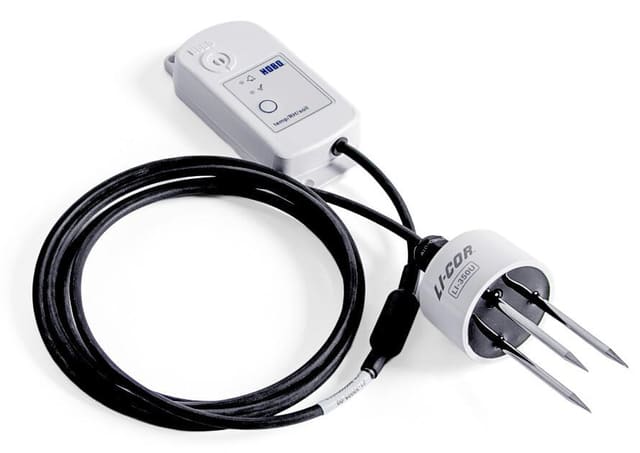
LI-COR (HOBO, InTemp, LI-COR) · MX2307A
HOBO MX Soil EC/VWC/Temp Data Logger
Ideal for researchers and growers looking for accurate data to complete their plant growth picture, this Bluetooth-enabled, fully integrated logger delivers high precision measurements for soil moisture/EC, VWC, and temperature with an external sensor, as…
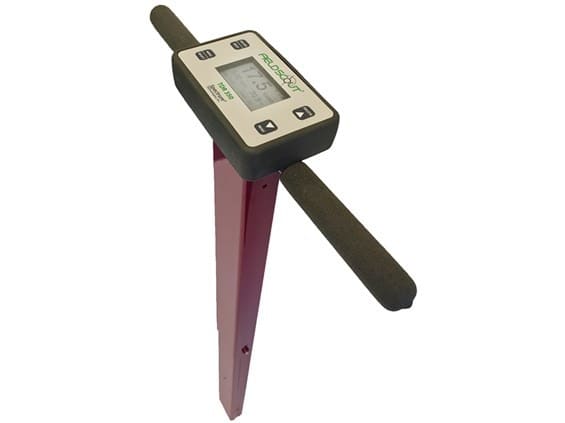
Spectrum Technologies · 6435
FieldScout TDR 350 Soil Moisture Meter with Case
Offering the proven time-domain measurement technology you have come to recognize for more than 30 years, the TDR 350 accurately measures soil moisture across the full range of soil conditions. Improved ergonomic design provides quick and easy measurements.…
Keep reading
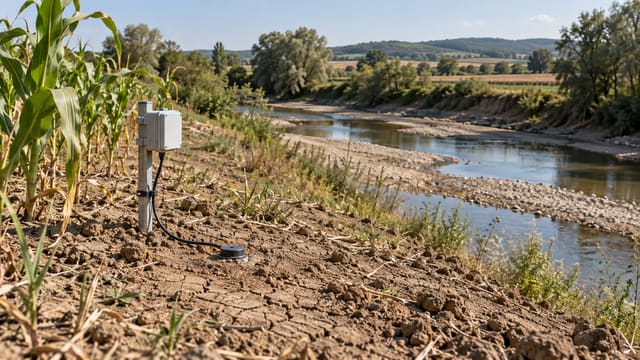
August 2026 in Europe: dry surface soil, low rivers and what to measure now
On 10 September, Copernicus published its August 2026 bulletins: exceptionally dry surface soils and river flows well below average across much of Europe. What those maps support deciding, and what they do not.
Week in review, 14 to 18 September 2026: your own point, the satellite and the laboratory curve
Three articles on what makes a number measured at one point trustworthy, three European signals from the week with their sources, and what is due in the coming days.
Sentinel-3C is in orbit: what a satellite measures and what your station still measures
On 15 September 2026 the European Union launched Copernicus Sentinel-3C. What it observes from 800 km, why land surface temperature is not air temperature, and what to log at your own point.