
Measure the tree or the soil to decide when to irrigate? What a dendrometer study in a Swiss apple orchard found
A study in a Swiss apple orchard compared dendrometer-driven irrigation with irrigation driven by soil moisture sensors over two seasons: the dendrometer treatment used 38% less water in 2022 and more than 45% less in 2023, with no significant difference in yield. What it allows us to conclude, what it does not, and what it changes in deciding what to measure.
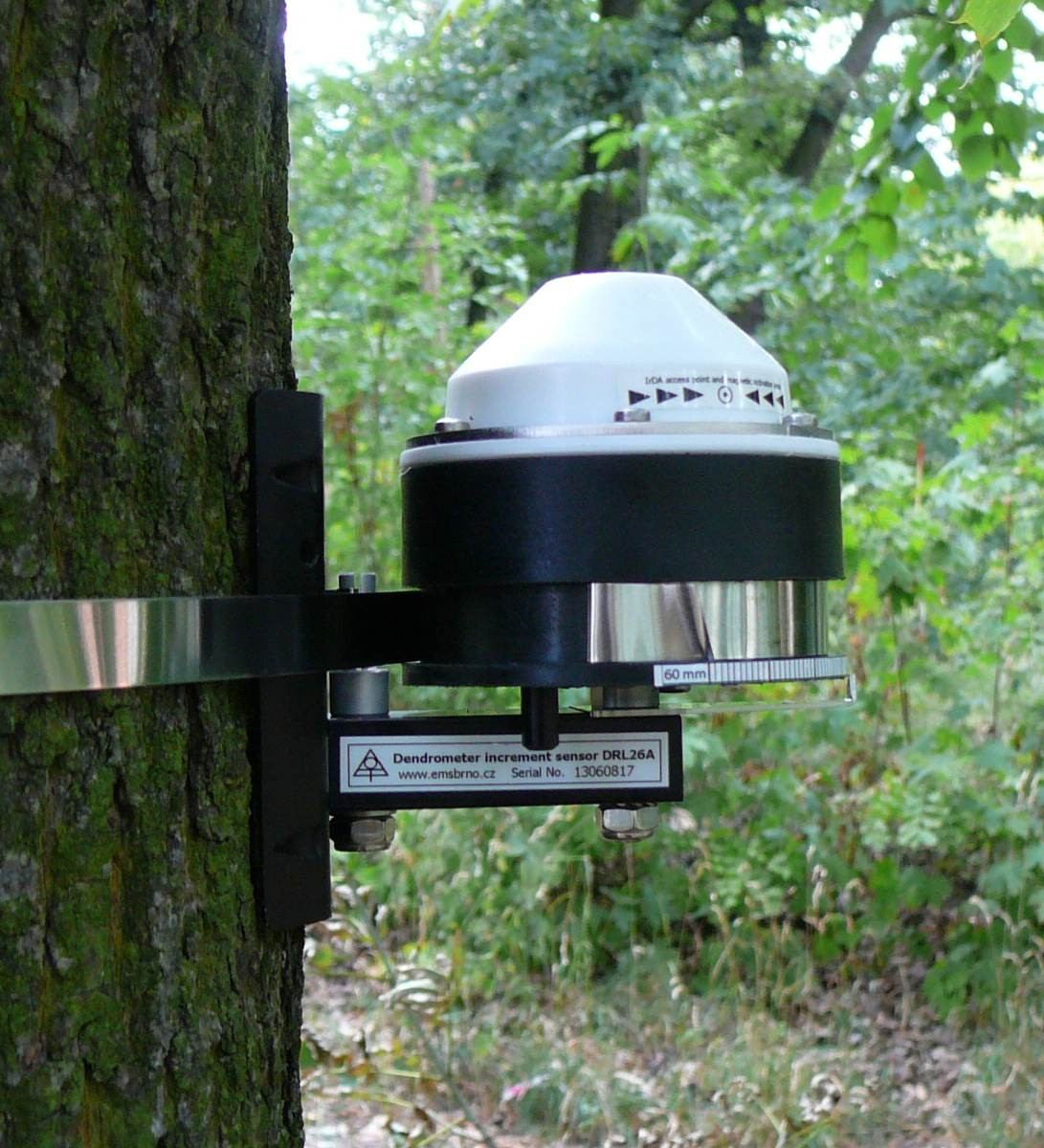
Anyone who schedules irrigation with soil sensors is measuring the soil: the water at a few points and a few depths. The tree gives a different signal. Trunk diameter changes over the day, and the difference between the daily maximum and minimum, known as maximum daily shrinkage (MDS), can be logged with a dendrometer. The practical question is which of the two readings to use when deciding to irrigate. A study by Agroscope and ETH Zürich, published in 2025, put this to the test over two seasons in an apple orchard in Switzerland. Here is what it found, what it does not allow us to conclude, and what it changes in a measurement decision.
The study question
Thainná Waldburger and co-authors compared automated irrigation driven by dendrometers (which they call DENDRO) with the farm's usual commercial approach, driven by soil moisture sensors (SOIL). They wanted to know whether the trunk signal makes it possible to match irrigation to what the tree needs, with less water and no loss of yield, and to check this they also measured stem water potential.
How it was done
- The site. An apple farm in the Lake Geneva region, at about 400 m above sea level, with a temperate oceanic climate according to Köppen-Geiger, a mean temperature of 11.2 °C and about 1030 mm of rain a year.
- The trees. 45 'Gala' apple trees in three randomised blocks, each with both treatments. Drip irrigation, with emitters 0.75 m apart and a flow rate of 2.3 L/h.
- The control (SOIL). Six Watermark sensors at 25 and 50 cm depth, with thresholds of -30 to -60 kPa (median at 25 cm) and -20 to -40 kPa (median at 50 cm).
- The dendrometers (DENDRO). Linear potentiometers (model SLPT 25 mm, by Opkon) mounted on an aluminium frame and held against the trunk with a 2.5 mm rubber band, with a resolution of ±6.1 µm. Of the 12 sensors installed, only 8 were used after data quality analysis.
- The decision rule. Every day at 8:00 the data were fetched. The algorithm compared the 7-day average of the trunk's daily recovery with the 7-day average of MDS (a difference they call RΔ). With a positive RΔ, irrigation was calculated from MDS; with a negative RΔ, which the authors read as tree shrinkage and water stress, irrigation increased the following day. Irrigation ran between 17:00 and 23:54.
- The reference. Stem water potential measured weekly around midday (12:00 to 14:00) with a Scholander chamber.
- The duration. About 57 days in 2022 (26 June to 22 August) and 90 days in 2023 (1 June to 30 August).
They also simulated, for both years, two further methods that were not applied in the field: one based on the FAO calculation and a regression model.
What was observed
- Water. The DENDRO treatment received 80 mm in 2022, 38% less than SOIL, and 90 mm in 2023, more than 45% less.
- Yield. SOIL produced 43.4 t/ha in 2022 and 50.5 t/ha in 2023; DENDRO, 42.8 and 48.7 t/ha. The authors found no significant differences.
- Water status. Mean stem water potential was -1.2 MPa under DENDRO in both years (minima of -1.5 and -1.7 MPa) and -1.0 MPa under SOIL (minima of -1.4 and -1.2 MPa). The DENDRO means were somewhat more negative, but the difference was not significant.
- Simulated methods. The FAO method tended to overestimate water requirements. The authors themselves warn that the simulation is not an independent test.
On this evidence, the authors conclude that in their trial the DENDRO method was more water-efficient than SOIL without compromising yield.
What this study does not allow us to conclude
- Climate and region. It is a single farm, in a temperate oceanic climate with about 1030 mm of rain a year, and in 2023 there was a week with more than 50 mm. The percentage savings cannot be carried over to a dry Mediterranean summer or to another region.
- Crop. Drip-irrigated 'Gala' apple. The study says nothing about other species or other cultivars.
- Duration. Two seasons, of 57 and 90 days.
- The control. SOIL was the farm's commercial practice, and in August of both years there was over-irrigation because of manual irrigation by the farm itself. The saving is therefore measured against that particular practice, not against any soil-sensor irrigation.
- Soil. The soil had a heterogeneous, compacted structure, and the authors note that soil moisture measurements did not always reflect water availability in deeper layers.
- Incidents. A faulty valve left the DENDRO trees without irrigation for more than 10 days, and 4 of the 12 dendrometers were discarded.
- Equipment. The study used linear potentiometers on an aluminium frame, held with a rubber band and with a resolution of ±6.1 µm. Its results do not automatically carry over to another dendrometer with a different fixing or resolution.
- Algorithm. With 7-day averages the system responds less well to rapid changes; the authors propose testing periods of 4 days or less.
What it changes in a measurement decision
- Decide what you measure. The soil at a few points, or the tree's response. In this study the trunk signal allowed irrigation with less water and no significant loss of yield, and the authors suggest combining soil sensors with plant-based measurements.
- Install with a margin. If only 8 of 12 dendrometers gave usable data, the number of instrumented trees has to allow for losses and for a data quality check before the data are used to decide.
- Keep an independent reference. In this study it was stem water potential, measured weekly at midday with a pressure chamber, that made it possible to check the water status of each treatment.
- Choose the calculation window. With 7-day averages the system reacts late; shorter windows are worth testing on your own plot, as the authors propose.
- Sort out the data flow. The study's algorithm needed the data every morning to decide that evening's irrigation. If the dendrometer is going to decide the day's irrigation, work out first how the data will arrive and how often.
- Do not forget depth. If soil sensors are kept, at 25 and 50 cm and in a heterogeneous soil they may miss the water in deeper layers, as the authors warn. Their calibration matters too, as we saw in this study on field calibration.
References
- Waldburger, T.; Anken, T.; Cockburn, M.; Walter, A.; Hatt, M.; Chiang, C.; Nasser, H.-R. (2025). Automated irrigation of apple trees based on dendrometer sensors. Agricultural Water Management, 311, 109398. DOI: 10.1016/j.agwat.2025.109398. CC BY 4.0 licence. Full text in the Agroscope repository. Accessed 21/10/2026; no correction or retraction notices in Crossref on that date.
Commercial selection by EIC Controls
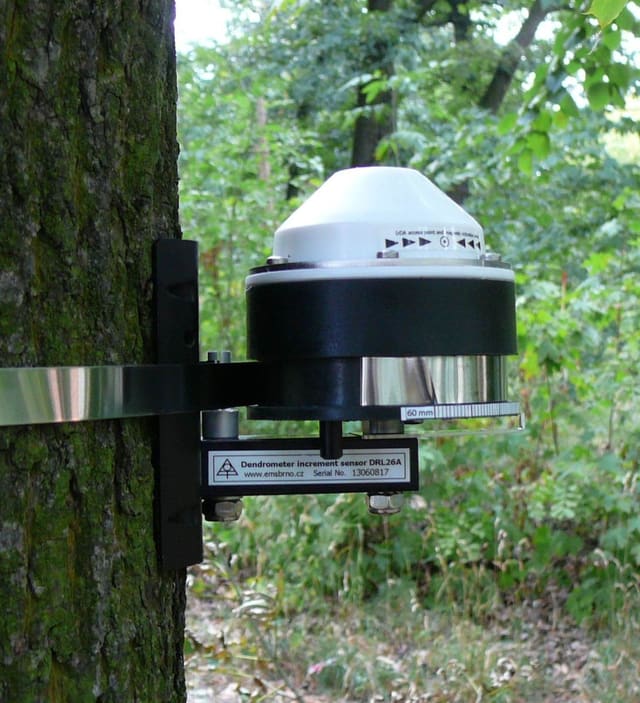
The DRL26C by EMS Brno is a logging sensor for long-term monitoring of trunk diameter changes in stems larger than 8 cm in diameter, with non-invasive fixing and an increment range of 65 mm, according to its datasheet. In a trial like the one described, it can log trunk diameter changes on the chosen trees. Before installing it, check the trunk diameters, plan for the ST20 stainless steel tape and the IrDA/USB data cable that the datasheet lists as necessary accessories, and confirm the resolution, logging interval and how the data will be downloaded with a specialist, since the datasheet does not give them, if the aim is to follow daily shrinkage.
Instruments for this application
EMS Brno · DRL26C
Stem increment sensor
Logging sensor for long term accurate monitoring of the tree trunk diameter changes in stems larger than 8 cm in diameter. Non invasive fixing Increment range 65 mm Memory and battery capacity up to 5 years
Keep reading
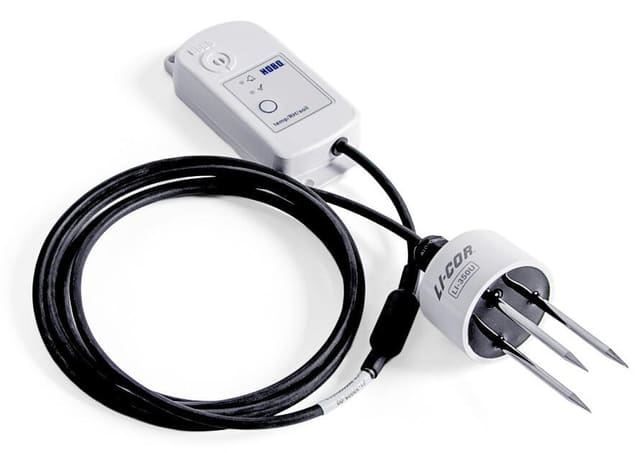
Field calibration or laboratory curve: what one study measured with soil moisture sensors
A study published in May 2026 calibrated low-cost capacitive sensors in the laboratory and then moved them to real plots. The laboratory curve drifted in the field, and a single reference measurement on site recovered much of the accuracy.
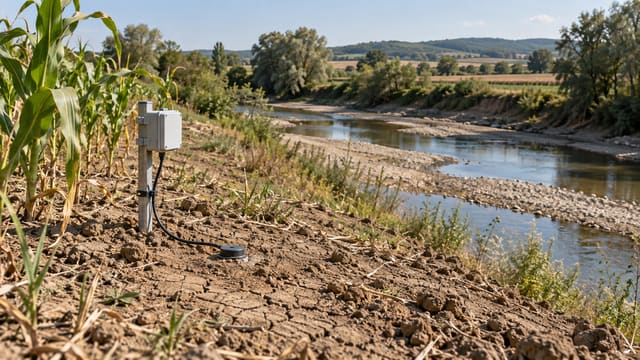
August 2026 in Europe: dry surface soil, low rivers and what to measure now
On 10 September, Copernicus published its August 2026 bulletins: exceptionally dry surface soils and river flows well below average across much of Europe. What those maps support deciding, and what they do not.
How long does biofouling take to spoil a conductivity record? What a study with moored sensors in the Baltic measured
In a study off the southern Baltic coast, a conductivity sensor moored at 2 m with a used TBT cell was out of specification at the first comparison after deployment, on day 32; with a UVC emitter, the last references, after 237 days, were within the margin. What this changes when planning visits and references.