
Weather monitoring · Agriculture and soil
PAR or global solar radiation? How to choose a light sensor for the decision you need to make
Global solar radiation and PAR are not the same quantity and are not measured with the same sensor. Which decision needs which, how much the factor that converts one into the other changes with the sky, and what to record before installing.
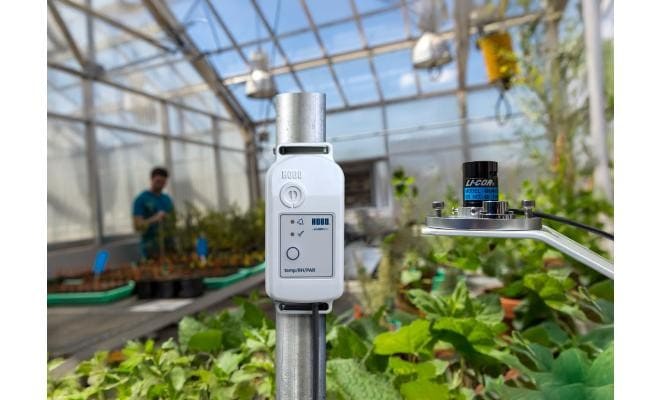
Before buying a light sensor, it pays to be clear about the decision the data will feed. To calculate reference evapotranspiration and schedule irrigation, solar radiation is needed in energy units. To know how much light useful for photosynthesis a crop receives, the quantity is a different one: photons between 400 and 700 nm. These are two different measurements, taken with different sensors, and converting one into the other with a fixed factor introduces an error that changes with the sky.
Two quantities, two sets of units
Global solar radiation (Rs) is the shortwave radiation, direct and diffuse, reaching a horizontal surface. It is expressed in W/m² as an instantaneous value and in MJ m⁻² day⁻¹ as a daily total, the unit used in FAO Irrigation and Drainage Paper 56. According to that paper, it can be measured with pyranometers, radiometers or solarimeters installed on a horizontal surface.
Photosynthetically active radiation (PAR) is the part of the spectrum that plants' biochemical processes use in photosynthesis: wavelengths between 400 and 700 nm. Because plant growth is directly related to photosynthetic photon flux density, the Burgos study cited below measures PAR as photons, in micromoles per square metre per second (µmol m⁻² s⁻¹), with a photon meter.
Which decision needs which
Irrigation from evapotranspiration. Chapter 3 of the FAO paper sets out the meteorological data that evapotranspiration methods require. There, net radiation (Rn) is the difference between incoming net shortwave radiation (Rns) and outgoing net longwave radiation (Rnl), and the shortwave term comes straight from Rs: Rns = (1 - α) Rs, with an albedo α of 0.23 for the hypothetical grass reference crop. A PAR sensor does not provide that figure. Where Rs is not measured, the paper offers the Angstrom formula, based on relative sunshine duration, the Hargreaves formula, based on the temperature difference, or data from a nearby station.
Light for the crop. The Burgos study cited below lists what accurate PAR estimates are needed for: modelling plant productivity and biomass production, natural illumination in greenhouses, plant physiology studies and leaf photosynthesis. For those decisions the quantity is PAR, and a pyranometer does not measure it directly.
Both at once. If the site serves both purposes, either both quantities are measured or one is measured and the other estimated, knowing how far the estimate can stray.
Converting with a fixed factor: what two measured series show
PAR is often calculated from global radiation, because there are far fewer ground measurements of PAR. The literature commonly gives the PAR/Rs fraction, in energy terms, a conventional value between 0.45 and 0.50.
Burgos. A study published in 2020 measured PAR and global radiation simultaneously at ten-minute intervals in Burgos (856 m above sea level), from April 2019 to January 2020, and classified the sky for each record using the CIE standard sky types. After quality control, 16,937 records remained. The mean ratio was 1.93 ± 0.15 µmol J⁻¹, with statistically significant differences between sky types: an average of 1.90 ± 0.11 µmol J⁻¹ under clear skies and 1.98 ± 0.16 µmol J⁻¹ under overcast skies. For the authors, the most influential factor in the ratio, over and above any daily or seasonal pattern, is an overcast sky.
Lindenberg. A study published in 2025 analysed eight years (2016 to 2023) of spectral measurements at a rural observatory in north-east Germany. The mean PAR/Rs fraction, in energy terms, was 0.433 ± 0.044: 43% of global radiation, below the conventional range. The fraction follows a seasonal cycle and depends on the sky: under clear skies it fell to 40.8 ± 2.0% in winter and rose to 43.5 ± 2.5% in summer; under overcast skies it reached 47.2 ± 6.2% in summer. The authors also found a long-term decreasing trend in these ratios and, at the same time, a strong correlation with global radiation (coefficients of determination above 0.90), which, according to the authors, suggests that, in the absence of direct spectral measurements, PAR can be reliably estimated from Rs.
What it means for the choice. The two findings are compatible: an estimate from Rs tracks the general course of PAR well, but the factor changes with the sky and the season, so the error of a fixed factor is not constant. In both series, under overcast skies the ratio rises and its standard deviation is larger. In practice:
- If PAR is context (comparing months or campaigns), estimating it from Rs with a documented factor may be enough.
- If a decision depends on the light on specific days, or the site has many overcast days, it is better to measure PAR.
- A published factor belongs to its place, its climate and its instruments. The two mean values above are not even in the same unit (photons per joule in Burgos, energy fraction in Lindenberg), and neither should be copied for another plot without checking it.
Under a canopy, in a greenhouse or under artificial light
Here the choice no longer hinges on a factor. LI-COR's documentation for its silicon pyranometer states that its spectral response is not ideal, that it does not cover the entire solar spectrum and that each unit is calibrated against a reference pyranometer under natural daylight. It therefore warns that it should only be used to measure unobstructed daylight, and that measurements under vegetation, cloud cover, artificial lights, in a greenhouse or of reflected solar radiation may not be accurate.
Cloud cover is on the list: a limitation worth knowing in the open too. And inside a greenhouse or under a plant canopy that silicon pyranometer is not the instrument: there, if the decision is about light for the crop, the quantity is PAR, measured with a PAR sensor.
What to decide and record before installing
- The decision the data feeds. Irrigation from ET0: global radiation, in W/m² and MJ m⁻² day⁻¹. Light for the crop: PAR, in µmol m⁻² s⁻¹ and, as a daily total, in mol m⁻² day⁻¹.
- Where the sensor goes. In the open with no obstructions, or inside the greenhouse or under the canopy. LI-COR's silicon pyranometer only in the first case.
- The unit of the daily total. A "daily light integral" may come in mol m⁻² day⁻¹ (PAR photons) or in MJ m⁻² day⁻¹ (solar energy), depending on the instrument. They are not comparable: check which one yours gives before comparing it with a crop reference.
- The factor, if you convert. Record the value, its unit (photons per joule or energy fraction), where it comes from and that it changes with sky type and season.
- Cleaning and recalibration. The FAO paper asks for the glass dome of pyranometers that have one to be wiped clean regularly. For recalibration, follow the manufacturer: LI-COR recommends every 2 years for its silicon pyranometer.
Limitations
- The two series come from two specific places: Burgos, at 856 m, over ten months (April 2019 to January 2020, short of a full year), and a rural observatory in north-east Germany over eight years. Neither covers other Iberian climates, greenhouse interiors or measurements under a plant canopy.
- Each study used its own instruments and expresses the ratio in its own unit: the values describe those sites, are not compared figure by figure and do not transfer as a factor to another.
- The restriction on the silicon pyranometer is the one its manufacturer states for its model; other sensors have their own documentation.
- This guide does not replace the sensor documentation or the ET0 calculation in the FAO paper.
References
- García-Rodríguez, A., García-Rodríguez, S., Díez-Mediavilla, M. and Alonso-Tristán, C. (2020). Photosynthetic Active Radiation, Solar Irradiance and the CIE Standard Sky Classification. Applied Sciences, 10(22), 8007. DOI: 10.3390/app10228007. Article on MDPI (accessed 5 October 2026).
- Moreno-Cuenca, L., Navas-Guzmán, F., Doppler, L. and Foyo Moreno, I. (2025). Evaluation of the Partition of Global Solar Radiation into UVA, PAR, and NIR Components in a Rural Environment. Remote Sensing, 17(20), 3439. DOI: 10.3390/rs17203439. Article on MDPI (accessed 5 October 2026).
- Allen, R. G., Pereira, L. S., Raes, D. and Smith, M. (1998). Crop evapotranspiration: Guidelines for computing crop water requirements. FAO Irrigation and Drainage Paper 56, chapter 3, Meteorological data. FAO. Chapter 3 on the FAO website (accessed 5 October 2026).
- LI-COR (n.d.). LI-200R Pyranometer: Performance Characteristics. Manufacturer documentation. LI-COR support page (accessed 5 October 2026).
Commercial selection by EIC Controls
To follow crop light, the HOBO MX2308 logger measures PAR (400 to 700 nm, up to 3000 µmol m⁻² s⁻¹ according to its datasheet) with a LI-COR PAR sensor, together with temperature and relative humidity, and allows the daily light integral to be calculated in mol m⁻² day⁻¹. For global radiation in the open, the MX2309 logs solar irradiance with a LI-COR silicon pyranometer (400 to 1100 nm), calibrated under natural daylight, as well as temperature and relative humidity. In both cases the installation point, the logging interval and how the data will be downloaded still need to be decided.
View the MX2308 datasheet · View the MX2309 datasheet · Talk to a specialist
Instruments for this application
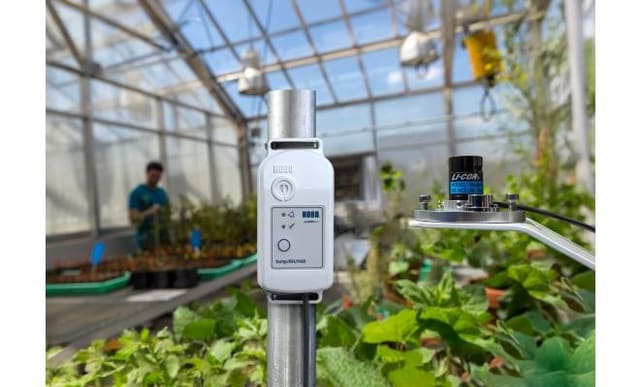
LI-COR (HOBO, InTemp, LI-COR) · MX2308
MX2308 HOBO Temp/RH/PAR Data Logger
Measures Temperature, RH & Photosynthetically Active Radiation (PAR) with LI-COR PAR sensor High-precision monitoring of PAR, temperature, and humidity with effortless Bluetooth data offload, ideal for monitoring environmental conditions—from agricultural…
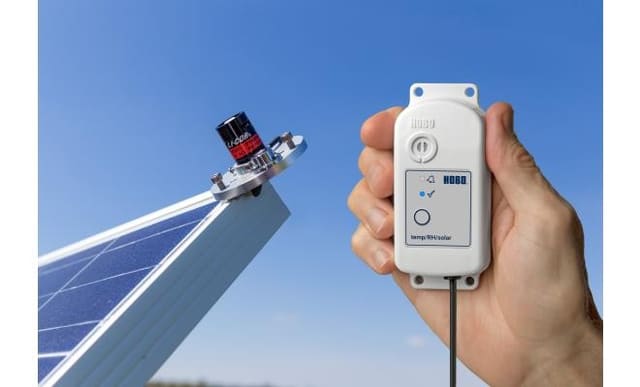
LI-COR (HOBO, InTemp, LI-COR) · MX2309
MX2309 HOBO Temp/RH/Solar Data Logger
Measures Temperature, RH & Solar Radiation with LI-COR 200R Pyranometer Research-grade, multiparameter microclimate monitoring solution with effortless Bluetooth data offload that continuously measures global solar radiation, temperature, and humidity. Ideal…
Keep reading
Is temperature enough to estimate ET0? What a study of 45 agricultural weather stations in Aragón found
At 45 SIAR network stations in Aragón (2004-2024), ET0 calculated from temperature alone rose at 36, while Penman-Monteith ET0 showed no significant trend at 33 and fell at 12. What this study allows you to conclude about which variables to measure, and what it does not.
August 2026 in Europe: dry surface soil, low rivers and what to measure now
On 10 September, Copernicus published its August 2026 bulletins: exceptionally dry surface soils and river flows well below average across much of Europe. What those maps support deciding, and what they do not.
Changing site or instrument without breaking the record: lessons from the Montseny summit series (1950-2025)
On 31 October 2026 AEMET and the SMC published an analysis of the Montseny summit series, which joins two sites and fills the gaps from 2001 to 2010. What it teaches anyone planning to move a station or change a sensor.