
Data logging · Temperature and humidity
Is it really between 2 and 8 °C? Where to put the probe in a vaccine refrigerator and what to log
In a German study of 75 vaccine refrigerators, only 24 stayed between 2 and 8 °C over seven days of logging. How to decide where the probe goes, whether it sits in air or in a buffer, how often to log and who reviews the data, drawing on guidance from Madrid and the Basque Country.
The fridge display reads 5 °C first thing in the morning and 5 °C again at closing time. In a German study of 75 vaccine refrigerators in 64 general practices, a data logger placed in the centre of each unit took one reading per minute for seven days: in only 24 refrigerators (32.0%) did the temperature stay between 2 and 8 °C for the whole period, and in 11 (14.7%) it reached 0 °C or below at least once (Thielmann et al., 2019).
This guide is about a measurement decision that is made once and shapes every record that follows: where the probe goes, whether it sits in air or inside a thermal buffer, how often readings are logged and who reviews them. What to do with the vaccines after a temperature excursion is not a measurement decision: it is set by the protocol of each site's health authority, and this text does not replace it.
1. Before the logger, the refrigerator
A good record documents a poor refrigerator; it does not fix it. In the German study, 66 of the 75 units were household refrigerators and 9 were pharmaceutical-grade. The mean temperature was the same in both groups, 5.3 °C, but the variation between units was not: each household refrigerator's mean temperature fell between -1.8 and 10.7 °C (standard deviation 2.8 °C), and each pharmaceutical one's between 4.3 and 7.9 °C (1.1 °C). With only nine pharmaceutical refrigerators, the comparison is descriptive.
Spanish guidance points the same way. The Basque Government's vaccination manual recommends refrigerators designed for vaccines and warns that refrigerators, especially household ones, may have a different temperature on each shelf. The Community of Madrid's technical guide considers industrial or pharmaceutical refrigerators the most advisable, says multi-airflow "No frost" models should not be used, because air coming from the freezer can push some areas below 0 °C, and rules out refrigerators with an internal freezer compartment.
What this changes for whoever measures: in a household unit, probe position matters more, because one shelf may not represent another.
2. Where the probe goes
Both guides agree on the essentials. Madrid asks for probe-based measuring instruments to sit in the central area of the refrigerator, away from the walls and the door. The Basque manual places the maximum/minimum thermometer in the central area, away from the walls and from the vaccine boxes to avoid misleading readings, and puts the digital thermometer's sensor in the middle section, not touching the walls. In the German study, the logger sat in the centre of each refrigerator, inside a plastic bin.
Neither guide allows vaccines to be stored in the door; Madrid also rules out the bottom drawers, and the Basque manual asks for a gap of 2.5 to 5 cm between the vaccines and the walls so that air can circulate.
The practical decision: the probe goes where the vaccines you want to watch are, in the centre, not touching walls or boxes, and its position is written down.
3. Probe in air or probe in a buffer
This is one of the decisions that most change what the record says. A probe in air measures the air inside, which changes every time the door is opened; a probe inside a buffer, such as a glycol bottle, responds more slowly. The authors of the German study list this as a limitation: for financial reasons they used a standard air probe, which measures the air temperature inside the refrigerator and the effects of door openings, whereas a slow-reacting glycol probe more closely resembles the temperature changes of the vaccine vials.
The Madrid guide leaves the choice open: the logger probe may be free or in an approved buffer, at the discretion of the site's medical equipment service. It also defines a cold chain break without any minimum duration: a maximum above +8 °C, or a minimum below +2 °C regardless of how long it lasted. Because that definition does not depend on duration, the probe type matters: the same door opening may be logged as a spike with an air probe and smoothed out with a buffer.
What to decide and write down: which probe is used, the buffer size if there is one, and how its spikes will be read. Switching from one to the other without noting it makes two months of records look as if they came from different refrigerators.
4. How often to log and who reviews the data
A reading of the current temperature on arrival and another on leaving does not see the night. The guides combine two things. Manual reading: Madrid asks for the temperature to be checked at least twice a day, first and last thing, and for the instrument to be reset after each reading; the Basque manual asks for a reading at the start and another at the end of the working day from the maximum/minimum thermometer, and recommends the last one at least an hour before the end of the working day. And continuous logging: Madrid gives an ideal interval of 10 to 15 minutes for the logger and, if it is computer-based, downloading the data at least once a week; the Basque manual asks for circular logging every 15 minutes.
The German study shows why looking at the unit is not enough. The authors describe a general belief that freezing would be noticed in the vaccines themselves, and signs such as cardboard boxes misshapen by thawing ice (in two practices) or thick ice walls (in one) went unnoticed. Madrid asks for the ice layer to be checked and kept no thicker than 5 mm.
The practical decision: an interval of 10 to 15 minutes if you follow these guides, one named person who downloads and reviews the record on a fixed day, and, at every manual check, a reading of the minimum and maximum, not only the current temperature.
5. Alarms and power cuts
A logger that only stores data tells you what happened when someone downloads it. The Madrid guide provides for an alarm system that warns of a power cut, mentions light, sound or SMS systems and leaves the choice to the site manager. It also asks for the refrigerator to be plugged directly into the mains, without multi-socket adaptors or extension leads, recommends a UPS and, in household refrigerators, bottles of salt water or cold packs at the bottom so that, in the event of a failure, the temperature holds for about 6 hours as long as the door stays shut.
For the temperature alarm, the guide sets no thresholds and no delay. The limits in its break definition (2 and 8 °C) are a reference point; the delay and who receives the alert must be decided before it goes off, and the decision depends on the probe type in section 3.
Checklist
- Refrigerator: type (household or pharmaceutical) recorded; no vaccines in the door or bottom drawers.
- Probe in the centre, not touching walls or boxes, with its position recorded.
- Probe type (air or buffered, and buffer size) recorded and unchanged throughout the period.
- Logging interval of 10 to 15 minutes, download on a fixed day and a named person responsible.
- Temperature and power-cut alarms, with recipient and delay decided.
Limitations
The study was carried out in 64 German practices from a teaching practice network that agreed to take part (38.1% of those invited), with mostly household refrigerators, over seven days and with an air probe; its percentages do not transfer as they stand to Spanish or Portuguese sites or to pharmaceutical refrigerators. The guides cited come from two Spanish regions, and each site follows the protocol of its own health authority. This text does not interpret regulations or decide what to do with exposed vaccines: that is for the health protocol and, where relevant, the vaccine manufacturer.
References
- Thielmann, A.; Puth, M.-T.; Kersting, C.; Porz, J.; Weltermann, B. (2019). Vaccine cold chain in general practices: A prospective study in 75 refrigerators (Keep Cool study). PLoS ONE 14(11), e0224972. DOI 10.1371/journal.pone.0224972. Full text in PubMed Central (accessed 26/10/2026).
- Comunidad de Madrid, Consejería de Sanidad, Dirección General de Salud Pública (2026). Guía técnica para la gestión de vacunas en centros de vacunación de la Comunidad de Madrid, January 2026 (accessed 26/10/2026).
- Gobierno Vasco, Departamento de Salud (2026). Manual de vacunaciones, capítulo 2.3: Control de cadena de frío y almacenamiento de las vacunas y productos inmunizantes, updated 14/10/2026 (accessed 26/10/2026).
Commercial selection by EIC Controls
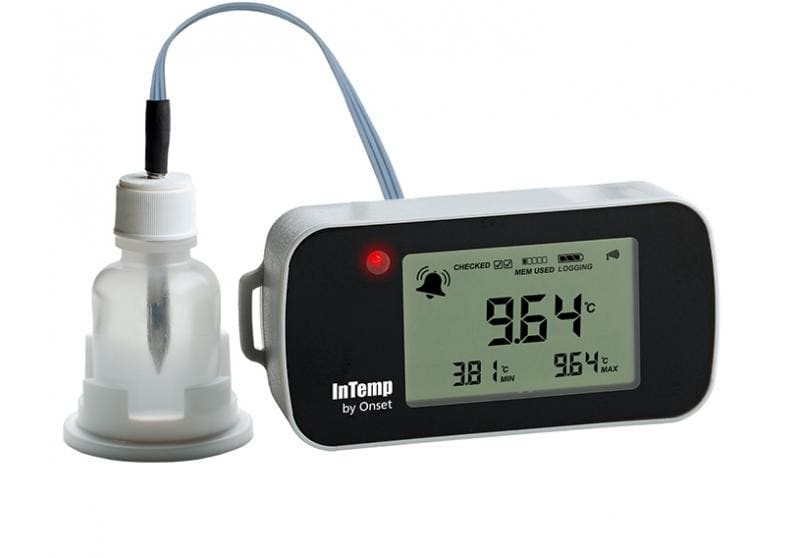
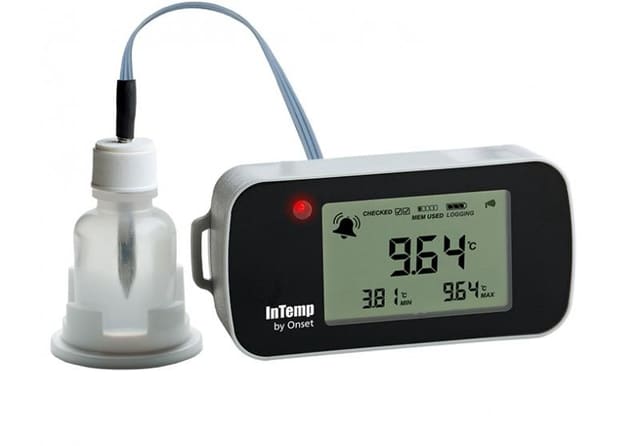
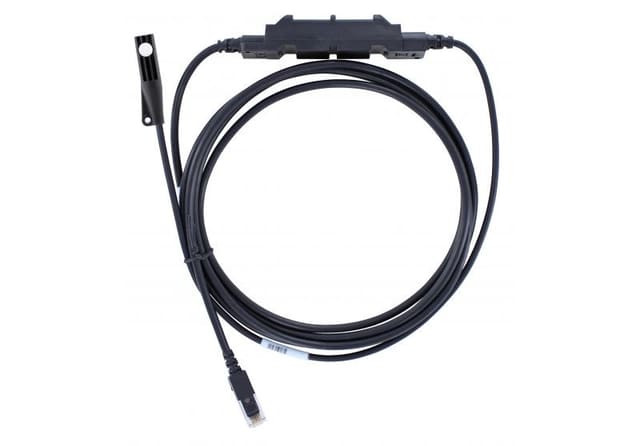
The InTemp VFC data logger measures temperature with an external stainless steel probe on a 2 or 4 m cable, attached to a glycol bottle, in other words the buffered-probe option in section 3. Its datasheet gives a typical response time to 90% of 10 minutes with the 5 mL bottle, 20 with the 15 mL bottle and 25 with the 30 mL bottle (air moving at 1 m/s), plus a display with the current temperature and daily minimum and maximum, audible and visual alarms, an internal ambient temperature sensor, logging intervals from 1 s to 18 h and power from two AAA batteries. Still to be sized: the bottle, the cable length depending on where the logger will sit, and how alerts will reach you remotely, which the datasheet links to an optional gateway.
Instruments for this application
LI-COR (HOBO, InTemp, LI-COR) · CX402-VFCxxx
InTemp VFC Bluetooth Low Energy Temperature (with Glycol) Data Logger
InTemp ® CX402-VFCXXX (with Glycol Bottle) data loggers monitor temperatures in refrigerators and freezers for clinics participating in the CDC Vaccines for Children program as well as hospitals, clinics, and WHO sites. The loggers communicate wirelessly via…
Keep reading
Monitoring the climate of a museum or church: how often to log, for how long and at how many points
One hour or less between readings, at least 13 months of data to apply the EN 15757 standard, and a first campaign with many points before deciding how many loggers to keep. These are the decisions supported by two studies in Valencia museums and a US National Park Service guide.
Week in review, 26 to 30 October 2026: what to note down alongside the data
The week's four articles (the logger's clock, the vaccine refrigerator, the European climate resilience law and replacing a humidity sensor), three signals with their sources (the Commission's new tools, the WMO greenhouse gas bulletin and climate indicators for tourism in southern Catalonia) and what comes next: COP31 from 9 November.
Replacing a humidity sensor can leave a mark in the record: what a study of 55 UK stations found
A study of 55 UK stations detected changes in measurement technique in humidity records; at one station, smaller detections were linked to routine sensor replacements. What it allows you to conclude, what it does not, and what to log in your own record.