
Data logging · Temperature and humidity
Week in review, 26 to 30 October 2026: what to note down alongside the data
The week's four articles (the logger's clock, the vaccine refrigerator, the European climate resilience law and replacing a humidity sensor), three signals with their sources (the Commission's new tools, the WMO greenhouse gas bulletin and climate indicators for tourism in southern Catalonia) and what comes next: COP31 from 9 November.
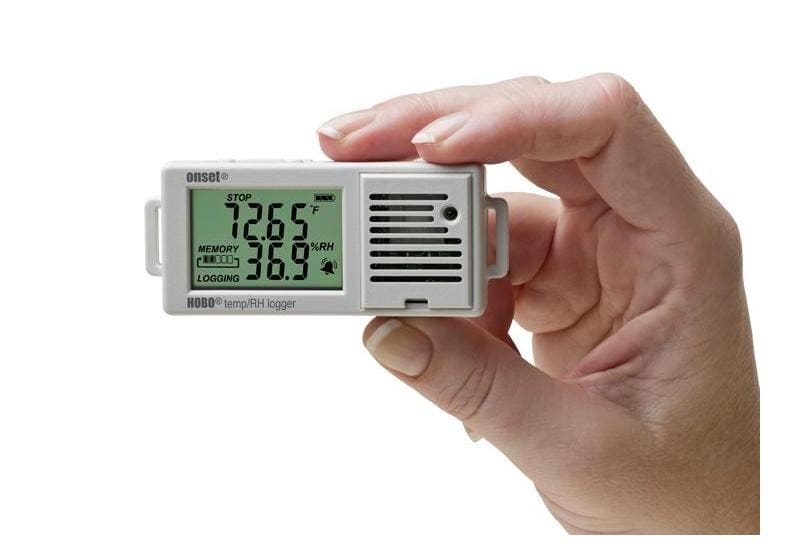
Four articles this week with one idea in common: a reading can only be compared if you know how it was obtained. The time base (local or UTC), the probe position and logging interval, the date of each sensor change and any move of the site are part of it.
What we published
- Monday 26. Week of 26 October to 1 November: with a settled week according to AEMET, the first point was the clock: on Sunday 25 October, official time in mainland Spain and the Balearic Islands went from UTC+2 to UTC+1; it is worth knowing whether each logger stores local time or UTC.
- Tuesday 27. Is it really between 2 and 8 °C?: in a German study of 75 vaccine refrigerators, only 24 stayed between 2 and 8 °C over seven days of logging; where the probe goes and how often to log.
- Wednesday 28. The Commission proposes a common warming trajectory: the proposed law provides for risk assessments based on a reference global warming trajectory, which does not describe your site; a record of your own does.
- Thursday 29. Replacing a humidity sensor can leave a mark in the record: a study of 55 UK stations detected changes in measurement technique in humidity records and, at one station, smaller detections were linked to routine sensor replacements.
Three signals this week
The Commission pairs the resilience law with more tools (27 October). Besides the European Climate Viewer, the Commission's news item presents the "Navigator of Climate Resilience Tools", which helps users find tools based on their location, sector and the risks they face, and the "Mission Solutions Explorer", with solutions from the EU Mission on adaptation. It also announces a European heatwave plan, a European water initiative and an initiative to identify Europe's 100 most climate-vulnerable territories. Why it matters: these are guidance tools at European scale; to know how heat or water shortage affects your site you still need a record of your own. Source: European Commission
WMO publishes Greenhouse Gas Bulletin No. 22 (27 October). According to the World Meteorological Organization, the global mean CO2 concentration reached 426.8 ppm in 2025, 2.8 ppm more than in 2024, and methane and nitrous oxide also hit new records. The analysis draws on the in situ observation network of WMO's Global Atmosphere Watch (GAW). Why it matters: these are global surface averages; they do not describe the air in a classroom or a greenhouse, where CO2 depends on ventilation and nearby sources (see where to put a CO2 monitor in a classroom). Source: WMO
Climate indicators for tourism on the Costa Daurada and in Terres de l'Ebre (28 October). On the AEMET blog, Anna Boqué-Ciurana and Enric Aguilar (Universitat Rovira i Virgili) built, in the IMPETUS project, indicators for six tourism products from hourly meteorological and oceanographic data covering 1958 to 2025 (from Open-Meteo and the SIMAR system of Puertos del Estado): the monthly percentage of climatically optimal days. Sun and beach exceeds 90 % optimal days in July and August; visits to the Ebro Delta and rice growing show a significant decline in optimal days. Why it matters: the post does not say whether the series come from stations or from models; before applying the indicator to your site it is worth knowing where the data come from and checking it against a measurement of your own. Source: AEMET blog
Coming up
For the week of 2 to 6 November, the sources consulted announce no dated official publications. After that:
- Monday 9 to Friday 20 November, COP31. The UN Climate Change Conference takes place in Antalya, Türkiye. Source: UNFCCC
- Monday 23 November, MARS Bulletin. The JRC calendar sets that date for the next "JRC MARS Bulletin - Crop monitoring in Europe". Source: JRC
References
Sources consulted on 30 October 2026, between 05:40 and 06:07 (Madrid time).
- European Commission (2026). "Protecting Europe with stronger climate-resilience". News item, 27 October 2026. https://commission.europa.eu/news-and-media/news/protecting-europe-stronger-climate-resilience-2026-10-27_en
- World Meteorological Organization (2026). "Greenhouse gas levels once again reach record high". Press release, 27 October 2026. https://wmo.int/node/39151
- World Meteorological Organization (2026). "WMO Greenhouse Gas Bulletin - No. 22". 27 October 2026. https://wmo.int/node/39152
- Boqué-Ciurana, A. and Aguilar, E. (URV, IU-RESCAT, C3) (2026). "Servicios climáticos para el sector turístico: de las mesas de co-creación a los indicadores climáticos. Científicos y usuarios trabajando juntos en la Costa Daurada y Terres de l'Ebre". AEMET blog, 28 October 2026. https://aemetblog.es/2026/10/28/servicios-climaticos-para-el-sector-turistico-de-las-mesas-de-co-creacion-a-los-indicadores-climaticos-cientificos-y-usuarios-trabajando-juntos-en-la-costa-daurada-y-terres-de-lebre/
- UNFCCC (2026). "UN Climate Change Conference - Antalya, November 2026". https://unfccc.int/cop31
- Joint Research Centre (2026). "JRC MARS Bulletin", publication calendar. https://joint-research-centre.ec.europa.eu/monitoring-agricultural-resources-mars/jrc-mars-bulletin_en
Commercial selection by EIC Controls
Product of the week: HOBO UX100-003 temperature and relative humidity data logger. According to its datasheet, it logs temperature and relative humidity indoors with built-in sensors and has an LCD display, visual alarms with high and low thresholds and a user-replaceable relative humidity sensor: if you replace it, note the date, so the change does not stay hidden in the record. Still to be sized: the placement, the logging interval (the datasheet allows from 1 second to just over 18 hours) and data download, which is via USB.
Instruments for this application
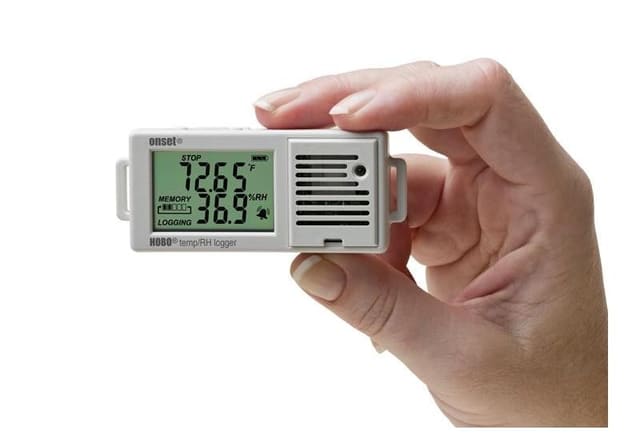
LI-COR (HOBO, InTemp, LI-COR) · UX100-003
HOBO Temperature/Relative Humidity (within 3.5% accuracy) Data Logger
The HOBO UX100-003 Temperature/Relative Humidity data logger records temperature and relative humidity (within 3.5% accuracy) in indoor environments with its integrated sensors. The data logger is ideal for monitoring occupant comfort in office buildings,…
Keep reading
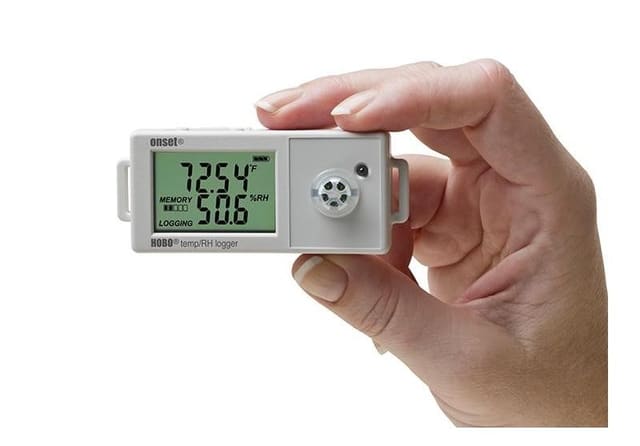
Monitoring the climate of a museum or church: how often to log, for how long and at how many points
One hour or less between readings, at least 13 months of data to apply the EN 15757 standard, and a first campaign with many points before deciding how many loggers to keep. These are the decisions supported by two studies in Valencia museums and a US National Park Service guide.
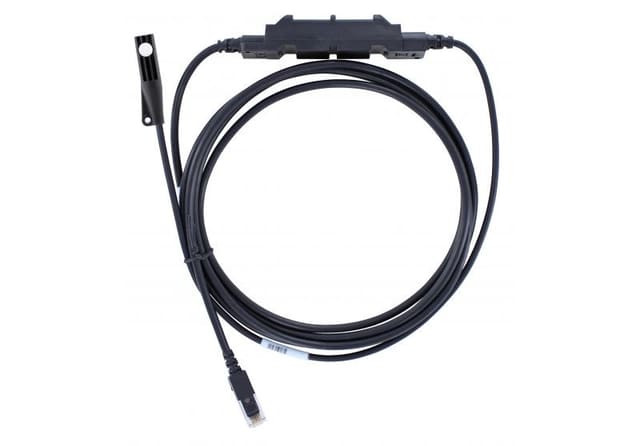
Replacing a humidity sensor can leave a mark in the record: what a study of 55 UK stations found
A study of 55 UK stations detected changes in measurement technique in humidity records; at one station, smaller detections were linked to routine sensor replacements. What it allows you to conclude, what it does not, and what to log in your own record.
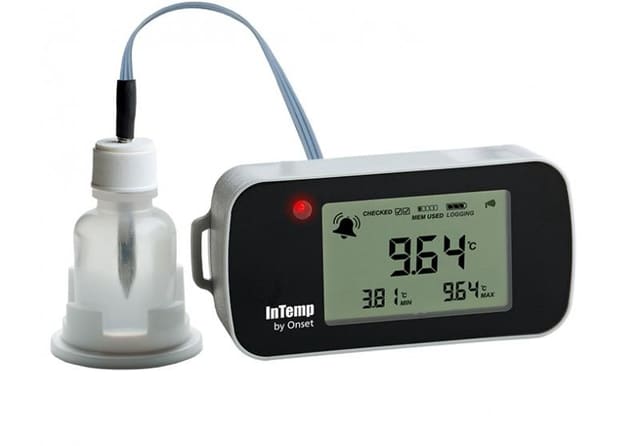
Is it really between 2 and 8 °C? Where to put the probe in a vaccine refrigerator and what to log
In a German study of 75 vaccine refrigerators, only 24 stayed between 2 and 8 °C over seven days of logging. How to decide where the probe goes, whether it sits in air or in a buffer, how often to log and who reviews the data, drawing on guidance from Madrid and the Basque Country.