
Week of 26 October to 1 November 2026: settled weather, little rain and the clocks just changed. What to measure and how carefully
AEMET expects a settled week with temperatures high for the time of year and scant rain, and more uncertainty from 2 November. Four signals and what to check in your series, starting with the time: on Sunday 25 October, official time in mainland Spain and the Balearic Islands went from UTC+2 to UTC+1.
Consulted: Monday 26 October 2026, between 05:35 and 06:00 mainland Spain official time (UTC+1). This is not an EIC Controls forecast: the forecast belongs to the service cited in each signal.
AEMET, Spain's state meteorological agency, expects a settled week with little rain, and the official time changed on Sunday. If your series does not say which time it is in, this is the week to write it down.
Signal 1: settled weather, temperatures high for the time of year and scant rain
AEMET describes the week of 26 October to 1 November as one of settled weather ("tiempo estable") in Spain. Temperatures will fall between Tuesday and Wednesday but will generally reach high values for the time of year, with maxima above 20 °C over wide areas and above 25 °C in the southern half of the peninsula and some places in the Mediterranean area. Rainfall will be scant, clearly below what is usual for these dates. Source: AEMET (forecast of 23 October).
For mainland Portugal, IPMA summarises precipitation for the first week as "valores abaixo do normal em todo o território" (below-normal values across the whole territory) (IPMA).
What to measure and how carefully. Read the maximum and the minimum separately: a mild week can be mild in the afternoons, at night or both, and the daily mean does not tell them apart (what to check before comparing your series with AEMET). If the sensor is outdoors, check the radiation shield (how to choose one).
Signal 2: from 2 November, more uncertainty and possible easterlies
For the week of 2 to 8 November, AEMET warns of greater uncertainty in the forecast: a drop in temperature is likely over much of the north and east of the peninsula, and humid easterly winds ("vientos de levante húmedos") could predominate, bringing rain to some places on the Mediterranean seaboard, with drier weather in the west. From 9 to 15 November, the uncertainty is greater still. Source: AEMET (forecast of 23 October).
What to measure and how carefully. Do not plan around a trend, but use the dry days to prepare the rain gauge: a clean, level funnel, enough battery and memory, and a short interval or event logging if you care about intensity (tipping bucket rain gauge guide).
Signal 3: the clocks changed on Sunday. Which time is your series in?
On Sunday 25 October, the last Sunday of the month, Spain's official time returned to winter time. According to a 2018 post on AEMET's blog, official time in mainland Spain and the Balearic Islands is UTC+2 in summer and UTC+1 in winter, and in meteorology all data and maps are usually referred to UTC ("todos los datos y mapas suelen ir referidos a la hora UTC"). Source: AEMET (Coordinated Universal Time).
What to measure and how carefully. Record in the metadata which time base your logger and your software use. If the series is in local time, early Sunday morning had a repeated hour. If the logger keeps the time it was set to in summer, it has been one hour ahead of the wall clock since Sunday, and that is not a sensor fault. To compare with official data, use the same base: in winter, 14:00 in mainland Spain is 13:00 UTC. At the next download, compare the logger's time with a reference and note any difference.
Signal 4: the drought in the background, with data from late September
The European Drought Observatory (Copernicus) summarises its latest available European analysis, with data from late September: "In late September, drought conditions remained critical in most of Europe", with above-average temperatures and a heatwave in south-western Europe, France and north-western Russia. Source: Copernicus (European Drought Observatory).
What to measure and how carefully. This is a continental indicator from almost a month ago, not the state of your plot. If you measure soil moisture, follow every depth and not just the surface layer (why the profile matters), and date any comparison with the indicator.
Checklist
- Time base (UTC or local time) in the metadata, with the date of the 25 October change.
- Logger time compared with a reference at the next download.
- Maximum and minimum read separately.
- Radiation shield and rain gauge checked.
- Comparisons with external data dated and on the same time base.
Limits
The forecast belongs to AEMET and, for Portugal, to IPMA; according to AEMET itself, uncertainty grows from 2 to 15 November. No maps, tables or forecast series are reproduced here: consult the sources. The Drought Observatory analysis is at European scale and refers to late September. The AEMET post on UTC dates from 2018.
References
- AEMET (2026). Predicción para las semanas del 26 de octubre al 15 de noviembre de 2026. Aemetblog, 23/10/2026. aemetblog.es. Accessed 26/10/2026.
- IPMA (2026). Boletim Previsão Mensal (Continente), 21/10/2026. ipma.pt. Accessed 26/10/2026.
- Gutiérrez, D., AEMET (2018). Hablando del tiempo. Tiempo Universal Coordinado (UTC). Aemetblog, 27/10/2018. aemetblog.es. Accessed 26/10/2026.
- Copernicus Emergency Management Service, European Drought Observatory (2026). Drought in Europe in late September 2026. drought.emergency.copernicus.eu. Accessed 26/10/2026.
Commercial selection by EIC Controls
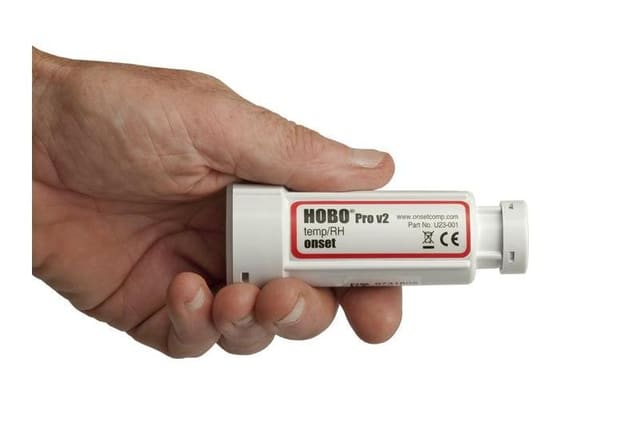
The HOBO U23 Pro v2 temperature and relative humidity data logger measures temperature and relative humidity in a weatherproof housing, with an accuracy of ±0.21 °C from 0 to 50 °C and ±2.5% RH from 10 to 90% (typical), and logging intervals from 1 s to 18 h. Its real-time clock has a stated drift of ±1 minute per month from 0 to 50 °C: one more reason to check the time at every download, as suggested above. Still to be sized: the measurement point, a radiation shield if it is installed outdoors, and data download, which the datasheet describes as an optic USB interface with HOBOware software.
Instruments for this application
LI-COR (HOBO, InTemp, LI-COR) · U23-001
HOBO U23 Pro v2 Temp/Relative Humidity data logger
The HOBO Pro v2 Temperature/Relative Humidity data logger is a weatherproof data logger with built-in temperature and relative humidity sensors. The Relative Humidity sensor provides superior durability in humid environments and is user-replaceable.
Keep reading
Changing site or instrument without breaking the record: lessons from the Montseny summit series (1950-2025)
On 31 October 2026 AEMET and the SMC published an analysis of the Montseny summit series, which joins two sites and fills the gaps from 2001 to 2010. What it teaches anyone planning to move a station or change a sensor.
Week of 2 to 8 November 2026: possible frosts inland in the north and rain on the Mediterranean. What to measure and with what care
AEMET expects a week that will probably be warmer than normal in southern Spain, with possible night frosts inland in the north and the heaviest rain in the Mediterranean area and the Balearics. Four official signals, including the new regionalised seasonal forecasts, and what to measure with each.
The Commission proposes a common warming trajectory for climate risk assessments: what to measure at your site to read it
On 27 October 2026 the European Commission proposed the European Climate Resilience Law, with a reference global warming trajectory and periodic risk assessments. What that information describes, what it does not describe about your site and what is worth recording.