
Weather monitoring · Temperature and humidity
Mainland Spain's warmest September since 1961 was a month of maxima: what to check in your series before comparing it with AEMET
AEMET reported on 16 October 2026 that September was the warmest in mainland Spain since 1961; according to the accompanying advance summary, average maxima were 4.6 °C above normal and average minima 2.1 °C above. What to check in your own series before comparing it with official figures that are still provisional.
If you run a temperature logger in a field, on a roof or next to a warehouse, September 2026 is the month you will most want to compare with the official figure. First, it helps to know what that figure says, which half of the day the heat came from, and why AEMET, Spain's national meteorological service, still presents it as provisional.
What AEMET has published
On 16 October 2026, AEMET released its climate summary for September. In mainland Spain, the mean temperature was 22.5 °C, 3.4 °C above the average of the 1991-2020 reference period. It was the warmest September since the series began in 1961, beating the previous record, set in 1987, by 0.7 °C. AEMET adds that, for the first time, a September had a mean temperature above the normal summer average, which is 22.1 °C for 1991-2020.
It was also a dry month: 15.9 mm over mainland Spain, 36% of normal, the seventh driest September in the series since 1961. Source: AEMET, Septiembre de 2026, el más cálido desde que hay registros (16/10/2026).
The heat came mainly by day
The advance climate summary that accompanies the news item, compiled on 6 October, separates the two halves of the day. The average of daily maximum temperatures was 4.6 °C above its reference value; the average of daily minima, 2.1 °C. As a result, the mean daily temperature range was 2.5 °C above normal for a September.
Station records tell the same story. At 45 main stations, the September mean temperature was the highest in their series; 53 recorded their highest average of daily maxima and 18 their highest average of daily minima; at 15, all three records coincided. The highest maximum of the month was 44.4 °C, at Morón de la Frontera, on the 3rd. After the heatwave of 2 to 7 September on the mainland and the Balearic Islands, there were two further warm spells (13 to 15 and 21 to 22) that did not reach heatwave status and were characterised mainly by high daytime temperatures.
The pattern was not uniform: over most of the mainland the anomaly was between +3 and +4 °C, with some points close to +5 °C, while in coastal areas of the north and the Mediterranean it was around +2 °C. Source: AEMET, Avance Climático Nacional de septiembre de 2026.
What to measure and what to check in your series
- Maxima and minima, separately. A daily or monthly mean blends two signals that were very different this month (+4.6 °C against +2.1 °C). Work out the average of daily maxima and the average of daily minima for your site, and compare each with those of a nearby official station.
- Make sure the maximum really is the maximum. If your logger stores one instantaneous reading per interval, the daily maximum you get is the highest of those readings, not necessarily the true peak, and the longer the interval, the fewer readings there are to catch it. If your equipment can record the maximum and minimum of each interval, consider using that option, and note in your metadata which mode you use: a series of instantaneous maxima and a series of per-interval maxima are not the same series.
- Check the shield before trusting the maximum. Maxima occur in the sunny hours. If yours sit clearly above those of the nearest official station, check that the radiation shield is clean, unobstructed and ventilated before accepting the value; the reasons are in our radiation shield guide.
- Validate before comparing. AEMET warns that the data used to compile this advance summary are provisional and subject to later validation. Apply the same standard to yours: gaps, out-of-range readings, sudden jumps, the logger clock (and whether it stores local time or UTC) and any change of location. Record what you corrected and why.
- The right reference. The +3.4 °C is an average for mainland Spain against 1991-2020, and on some coasts the anomaly was around +2 °C. To speak of an anomaly at your site you need a long reference for that same site, or for a nearby and comparable official station; with only a few years of data, a record of your own says little, as we explained in what a record means at your station.
What is not yet known
- The figures in the advance summary are provisional and subject to later validation, so they are best quoted as an advance and not as a final assessment.
- The advance summary describes mainland Spain and its main stations, not any particular site: with anomalies of around +2 °C on some coasts and close to +5 °C at some points, what happened at your site is only in your own record.
- The gap between maxima and minima is the one for the mainland as a whole; at your site it may be larger, smaller or absent.
- This article is not a forecast: it does not anticipate what October or the rest of the autumn will be like.
References
- AEMET (2026). Septiembre de 2026, el más cálido desde que hay registros. News item published on 16/10/2026. https://www.aemet.es/es/noticias/2026/10/resumen_septiembre2026 (accessed 21/10/2026, 06:45 Madrid time).
- AEMET (2026). Avance Climático Nacional de septiembre de 2026. Compiled on 06/10/2026. https://www.aemet.es/documentos/es/noticias/2026/10/avance_climatico_nacional_septiembre_2026.pdf (accessed 21/10/2026, 06:45 Madrid time).
Source of the climate data: AEMET.
Commercial selection by EIC Controls
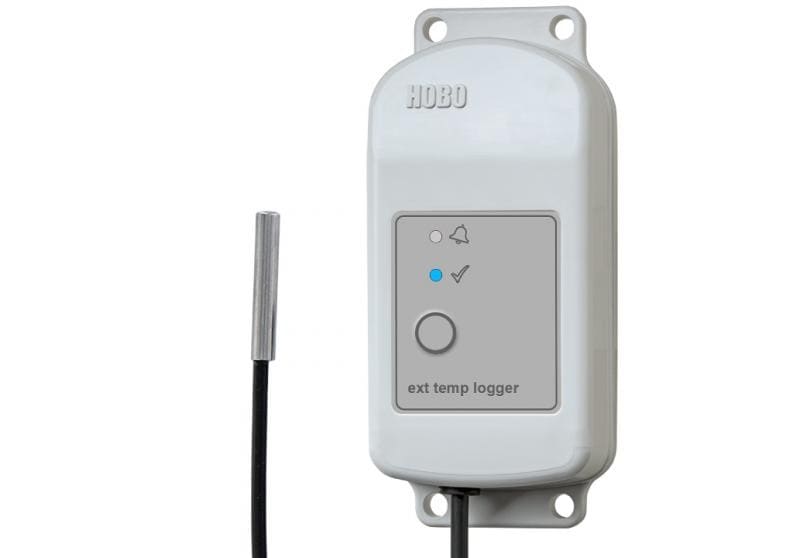
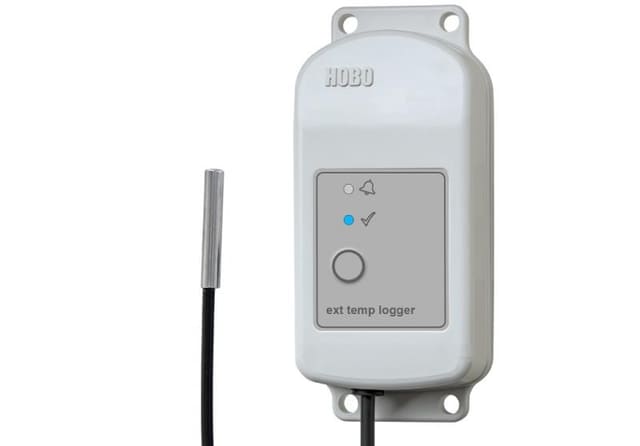
The MX2304 is a temperature logger with one external sensor on a 2 m cable, in a weatherproof housing (IP67), with an accuracy of ±0.2 °C from 0 to 70 °C, a configurable logging interval from 1 s to 18 h and normal, statistics or burst logging modes. In a context like this September's, it lets you keep your own temperature series at your site, with the interval and logging mode recorded from day one. Still to be sized: the solar radiation shield and its bracket, the installation height, the logging mode and the Bluetooth download routine (range of approximately 30 m line of sight).
Instruments for this application
LI-COR (HOBO, InTemp, LI-COR) · MX2304
HOBO data logger with external temperature sensor
The HOBO MX2304 is a weatherproof data logger with one external temperature sensor. Leveraging Bluetooth Low Energy, the logger enables easy, fast set up and data download directly from your mobile device, and provides high-accuracy measurements in harsh…
Keep reading
Week in review, 12 to 16 October 2026: humidity, from the air to the leaf
The week's two pieces, linked by relative humidity (from the dew point to leaf wetness), three European signals with their sources, and what is coming: the European climate resilience framework expected on 20 October and the end of summer time on the 25th.
Record heat stress in summer 2026: what your station's thermometer does not measure
On 2 October 2026 Copernicus published its review of the European summer: western Europe averaged a record 41 days of at least ‘strong’ heat stress. The index behind it combines four variables, and a station that logs only air temperature provides one of them.
Sentinel-3C is in orbit: what a satellite measures and what your station still measures
On 15 September 2026 the European Union launched Copernicus Sentinel-3C. What it observes from 800 km, why land surface temperature is not air temperature, and what to log at your own point.