
Weather monitoring · Temperature and humidity
Week in review, 12 to 16 October 2026: humidity, from the air to the leaf
The week's two pieces, linked by relative humidity (from the dew point to leaf wetness), three European signals with their sources, and what is coming: the European climate resilience framework expected on 20 October and the end of summer time on the 25th.
If your station logs relative humidity, the blog gave you two uses for it this week: comparing days through the dew point and estimating hours of leaf wetness. Here is what we published, what happened in Europe and what is coming.
What we published this week
Week of 12 to 18 October: the anticyclonic week AEMET expected, after a September that Copernicus ranks as the third warmest on record in Europe, and why, between warmer and cooler days, the dew point gives a better comparison than relative humidity.
How long did the leaves stay wet?: where to put the leaf wetness sensor, at what angle and orientation, and why a relative humidity threshold that works in one orchard cannot be used in another without checking (in 14 commercial citrus orchards, the optimum ranged from 72.5% to 89.5%).
The common thread: relative humidity cannot be compared between days without looking at temperature, and its threshold cannot be moved from one plot to another without your own observations.
Three signals from Europe
Water as a condition for hydrogen in southern Europe. On 8 October 2026 the European Commission's Joint Research Centre (JRC) concluded that Europe's hydrogen ambitions are achievable "without major water crises, but only with proactive planning". According to its analysis, only 1 in 10 hydrogen plants could face noticeable competition with other freshwater uses (agricultural, municipal or industrial) under pessimistic climate scenarios, and southern Europe, with Spain, Italy and Portugal, faces the highest risk. Source: JRC. Why it matters: the JRC recommends assessing the siting of production hubs against the water available in each basin and lists monitoring seasonal water stress among the key steps.
Ibero-American water, meteorology and civil protection officials meet in Madrid. On 13 October 2026 the 3rd Joint Meeting of CODIA and CIMHET opened in Madrid, bringing together water, meteorology and civil protection officials from Ibero-American countries. According to AEMET's news item, the Director-General for Water, M.ª Dolores Pascual, said that artificial intelligence can help improve forecasts provided there are adequate observation networks and trained professionals to interpret the results. Source: AEMET. Why it matters: in that statement, what artificial intelligence can add to forecasts depends on adequate observation networks.
Europe's climate in 2026 at Brussels Climate Week. From 12 to 16 October, Brussels Climate Week brings together European institutions, Member States and industry. On 12 October ECMWF announced that it would showcase the Copernicus Climate Change Service (C3S) and the Copernicus Atmosphere Monitoring Service (CAMS) there, with an overview of the European climate in 2026 based on their data on extreme heat, drought, wildfires and ozone pollution. Source: ECMWF. Why it matters: Copernicus data are also the basis of the EU climate hazard viewer that the Commission is preparing for regional and local actors (see the agenda).
What is coming
Tuesday 20 October: European framework for climate resilience. According to a European Parliamentary Research Service (EPRS) briefing of 2 September, the Commission is expected to present a European integrated framework for climate resilience that day, including a communication, a legislative proposal for a regulation, a recommendation and a Commission Decision, and a common reference trajectory based on global warming of 3 °C in 2100. The same briefing says the Commission is about to launch the first prototype of an EU climate hazard viewer based on Copernicus data. Source: EPRS.
Sunday 25 October: summer time ends. Directive 2000/84/EC sets the end at 1.00 a.m. Greenwich Mean Time on the last Sunday in October. Record beforehand whether your logger stores local time or UTC. Source: EUR-Lex.
Further ahead, Monday 26 October: MARS Bulletin. This is the next edition of the JRC bulletin on crop monitoring in Europe, according to its schedule. Source: JRC.
References
- European Commission, Joint Research Centre (2026). "EU hydrogen expansion unlikely to strain most water supplies". joint-research-centre.ec.europa.eu. Accessed 16/10/2026, around 06:50 (Madrid time).
- AEMET (2026). "Hugo Morán defiende la cooperación iberoamericana para mejorar la prevención de los riesgos hidrometeorológicos". aemet.es. Accessed 16/10/2026, around 06:50 (Madrid time).
- ECMWF (2026). "ECMWF at Brussels Climate Week". ecmwf.int. Accessed 16/10/2026, around 06:50 (Madrid time).
- European Parliamentary Research Service (2026). "European integrated framework for climate resilience". eprs.europarl.europa.eu. Accessed 16/10/2026, around 06:50 (Madrid time).
- European Parliament and Council (2001). "Directive 2000/84/EC of the European Parliament and of the Council of 19 January 2001 on summer-time arrangements". eur-lex.europa.eu. Accessed 16/10/2026, around 06:50 (Madrid time).
- European Commission, Joint Research Centre. "JRC MARS Bulletin". joint-research-centre.ec.europa.eu. Accessed 16/10/2026, around 06:50 (Madrid time).
Commercial selection by EIC Controls
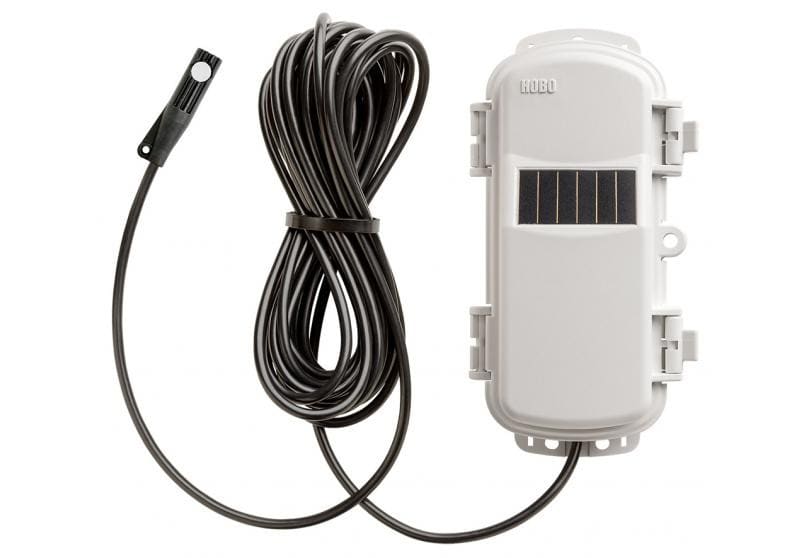
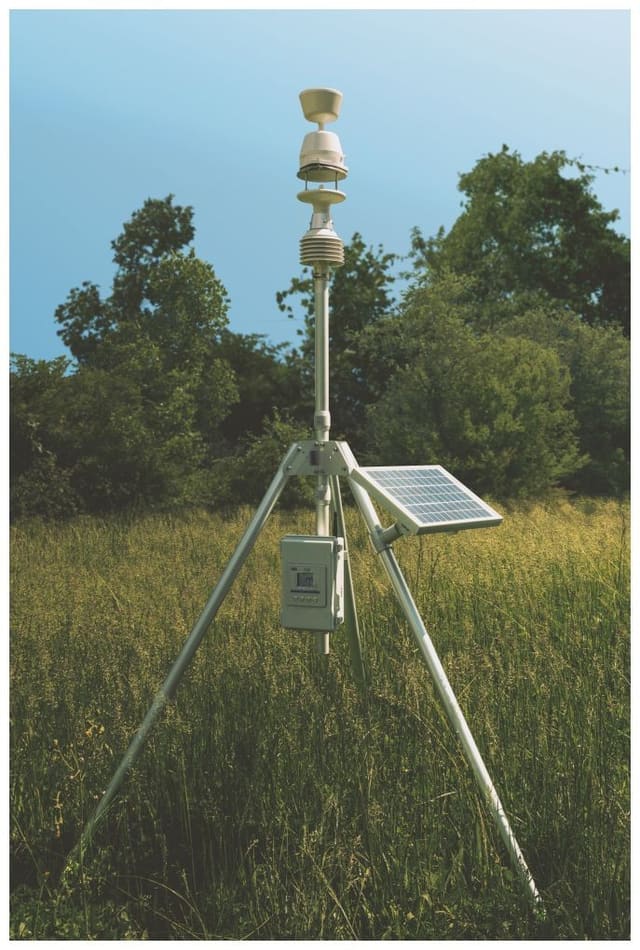
The RXW-THC-868 HOBOnet wireless temperature and humidity sensor measures air temperature and relative humidity and sends the data over an 868 MHz wireless mesh network. Its datasheet states ±0.2 °C from 0 to 70 °C and ±2.5% relative humidity from 10% to 90% (typical), a humidity sensor that withstands extended use in high-humidity environments, and power from rechargeable AA batteries with a built-in solar panel. We feature it this week because relative humidity was the thread running through both pieces, from the dew point to leaf wetness; still to be sized: the central station it transmits to, the range at your site (the datasheet gives 450 to 600 m) and the installation point and height.
Instruments for this application
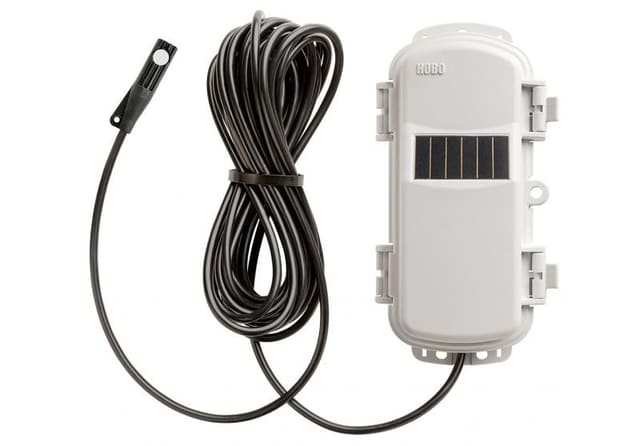
LI-COR (HOBO, InTemp, LI-COR) · RXW-THC-868
HOBOnet Temp/RH Sensor
The HOBOnet Wireless Temperature and Relative Humidity Sensor provides a cost-effective and scalable solution for web-enabled monitoring of air temperature and humidity. HOBOnet Wireless Sensors communicate data directly to the RX3000 weather station or pass…
Keep reading
Mainland Spain's warmest September since 1961 was a month of maxima: what to check in your series before comparing it with AEMET
AEMET reported on 16 October 2026 that September was the warmest in mainland Spain since 1961; according to the accompanying advance summary, average maxima were 4.6 °C above normal and average minima 2.1 °C above. What to check in your own series before comparing it with official figures that are still provisional.
Record heat stress in summer 2026: what your station's thermometer does not measure
On 2 October 2026 Copernicus published its review of the European summer: western Europe averaged a record 41 days of at least ‘strong’ heat stress. The index behind it combines four variables, and a station that logs only air temperature provides one of them.
Sentinel-3C is in orbit: what a satellite measures and what your station still measures
On 15 September 2026 the European Union launched Copernicus Sentinel-3C. What it observes from 800 km, why land surface temperature is not air temperature, and what to log at your own point.