
Weather monitoring · Installation and calibration
How long did the leaves stay wet? Where to put the sensor and how to set the threshold so the data are usable
Hours of leaf wetness feed many disease warnings, yet there is no standard way to measure them. Where to put the sensor, at what angle and orientation, whether to paint it and how to set the threshold with your own observations.
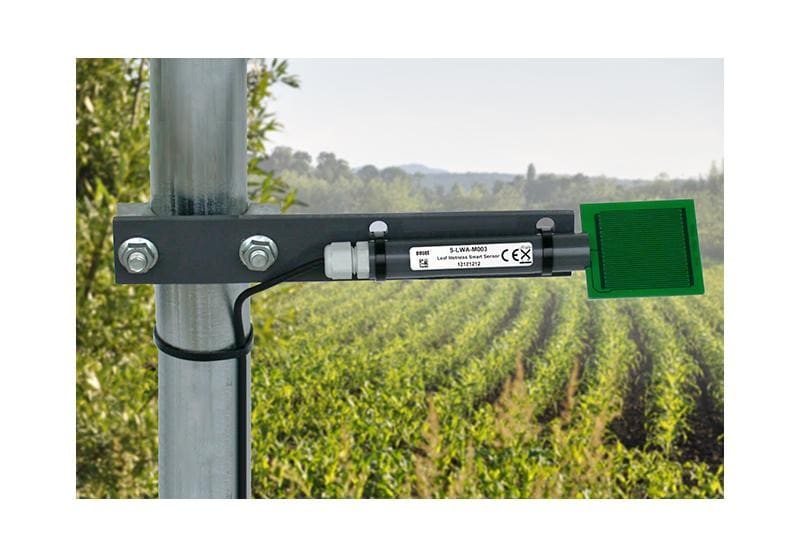
Many disease-warning systems use hours of leaf wetness as an input to tell growers when a spray is really needed. In Mediterranean citrus, for example, leaf wetness plays a part in diseases such as Alternaria brown spot of mandarin and melanose. The figure looks simple, but leaf wetness has no standard measurement system (Bassimba et al., 2017) and it is a difficult variable to measure or to estimate (Sentelhas et al., 2005).
Two sensors in the same field can count different hours on the same night, depending on where they are, how they are installed and which threshold is used to decide that the leaf is "wet". This guide sets out the four decisions that matter most: where to put the sensor, at what angle and facing which way, whether to paint it, and how to turn its reading into wet hours.
First decision: a comparable reference or a point inside the crop?
Reference over grass at 30 cm. A study in five crops (apple, maize, grapevine, coffee and muskmelon), at experimental stations in North and South America, compared a sensor placed 30 cm above mown grass with sensors inside each crop (Sentelhas et al., 2005). The sensor over grass gave good estimates of wetness duration at the top of the canopy, with mean absolute errors of between 0.83 and 1.58 hours, and poorer estimates inside the canopy. The University of Florida extension guide proposes the same 30 cm height over grass, outside the area wetted by sprinkler irrigation, and warns that a sensor at 2 m may not represent conditions at plant height (Onofre et al., 2020).
Sensor inside the crop. In the five-crop study, wetness duration was not the same throughout the canopy. In apple it fell from 8.67 hours at the top to 6.78 hours at the bottom; in maize, from 14.5 hours at the top to 13.53 hours inside. In grapevine and coffee there were no significant differences between positions. In apple and maize the top stayed wet for longer, particularly when the water came from dew, because it is the only part directly exposed to the sky. The authors support using at least two sensors to follow the difference between the top and the bottom of the canopy.
In Spain, a study at the experimental station of the Valencian Institute of Agricultural Research (IVIA) in Moncada (Valencia) measured in a citrus orchard between 2011 and 2013 at six positions: east side and west side, at 1, 1.5 and 2 m above the ground (Bassimba et al., 2017). Over nine nights of visual observation there were no significant differences between positions or between the upper and lower leaf surfaces. The sensors did record differences between west and east at 1 and 2 m on rainless days, which the authors describe as not substantial. They also note that nine nights were probably too few and that they did not measure below 1 m.
How to choose. If the data will feed a warning model or be compared with other stations, the reference exposure (30 cm over grass) makes them comparable. If what matters is how wet your crop gets, put the sensor inside the canopy and, if the canopy is dense, use two (top and bottom). Do not change the exposure mid-season without recording it: the series would no longer be comparable with itself.
Second decision: angle and orientation
All three references use a tilted sensor, not a flat one: 30 degrees from the horizontal in the Valencia study, 30 or 45 degrees in the five-crop study and between 30 and 45 degrees in the Florida guide, which says to face it north in the Northern Hemisphere. In the five-crop study, sensors faced north in the Northern Hemisphere and south in the Southern Hemisphere, that is, towards the pole. Set the angle and orientation on day one, record them and use the same settings on every sensor you intend to compare.
Third decision: to paint or not to paint
In the five-crop study, the flat-plate sensors were painted with two or three coats of off-white latex and heat-treated to increase their sensitivity, and the Florida guide warns that an unpainted flat plate may not detect small droplets of water. In the Valencia study, by contrast, the sensors were not painted, following the manufacturers' instructions. The rule: use each model as its manufacturer specifies, and do not mix sensors treated in different ways in the same network without checking that they give the same result.
Fourth decision: the threshold that turns a reading into wet hours
A leaf wetness sensor does not deliver wet hours: it delivers a continuous signal (for example, from 0 to 100), and someone, a person or a program, decides above which value the leaf counts as wet. In the Valencia study that threshold was calculated for each sensor type by comparing readings with visual observations, in which a leaf counted as wet when at least 10 % of its surface was wet. For one of the sensors, with a 0 to 15 scale, the optimum threshold ranged from 0.95 to 4.05 depending on the position in the canopy.
The alternative without a wetness sensor is to estimate it from relative humidity: count as wet the hours above a threshold. In the Moncada orchard, the optimum threshold was 87.45 %, and the authors note that growers could easily adopt the method in commercial conditions, because temperature and relative humidity sensors are already common in Spanish citrus orchards. But across 14 commercial orchards in seven provinces, from Tarragona to Huelva, the optimum threshold ranged from 72.5 % at Gandía to 89.5 % at Chiva, and at Isla Cristina the method performed much worse (area under the ROC curve of 0.65, against more than 0.83 at 12 of the 14 orchards). A relative humidity threshold does not carry over from one field to another without being checked.
Dew counts: at Moncada, 73.6 % of rainless days had wet leaves, which the authors link to dew. And slight condensation can be missed by the eye but detected by the sensor, so not every mismatch with observation is a sensor error.
What to do. Before relying on wet hours, note on a few nights whether the leaves are wet or dry, at dusk and at dawn, and compare that with the reading. If the sensor says "wet" when the leaves are dry, or the other way round, adjust the threshold before using the data in a model.
Maintenance
The authors of the Valencia study point out that the accuracy of these sensors is variable and that frequent calibration is usually needed. The Florida guide adds:
- Clean the sensor with water and a soft cloth; inspect it weekly during the planting season and every two weeks or monthly the rest of the time.
- Do not apply herbicide under the sensor, and mow the grass with light equipment rather than a tractor.
- Bury the cables to the data logger to protect them from animals and mowing.
- Inspect the sensor whenever the data look inconsistent.
Checklist
- Question decided: reference (30 cm over grass) or crop (inside the canopy, two sensors if it is dense), out of reach of the sprinklers.
- Tilt of 30 to 45 degrees and north-facing, the same on every sensor.
- Painted or not, as the manufacturer of the model specifies.
- Threshold checked against your own observations.
- Exposure, angle, orientation and threshold recorded in the station log.
Limits
- The studies cited cover citrus in Spain and five crops in the Americas; their thresholds and differences between positions do not carry over to other crops, climates or sensors without checking.
- The Valencia study is based on nine nights of visual observation and did not measure below 1 m; the maintenance advice comes from a University of Florida extension guide.
- This guide does not replace the instructions of your warning model: check with what exposure and what threshold the wetness data used to fit it were measured.
References
- Bassimba, D. D. M.; Intrigliolo, D. S.; Dalla Marta, A.; Orlandini, S.; Vicent, A. (2017). Leaf wetness duration in irrigated citrus orchards in the Mediterranean climate conditions. Agricultural and Forest Meteorology, 234-235, 182-195. doi:10.1016/j.agrformet.2016.12.025. Accepted manuscript in the IVIA repository: ReDivia. Accessed 12/10/2026.
- Sentelhas, P. C.; Gillespie, T. J.; Batzer, J. C.; Gleason, M. L.; Monteiro, J. E. B. A.; Pezzopane, J. R. M.; Pedro Jr., M. J. (2005). Spatial variability of leaf wetness duration in different crop canopies. International Journal of Biometeorology, 49, 363-370. doi:10.1007/s00484-005-0259-1. Accessed 12/10/2026.
- Onofre, T. B.; Fraisse, C. W.; Peres, N. A.; McNair, J. (2020, revised 2024). How to Avoid Common Problems with Leaf Wetness Sensor Installation and Maintenance. UF/IFAS EDIS, AE538. ask.ifas.ufl.edu/publication/AE538. Accessed 12/10/2026.
Commercial selection by EIC Controls
The Leaf Wetness Smart Sensor S-LWA-M003 measures leaf wetness with a capacitive grid, on a scale from 0 (dry) to 100 (wet); according to its datasheet it needs no painting or coating, and its bracket lets you set any angle between 0 and 90 degrees. If the measuring point is far from the station, the wireless version RXW-LWA-868 transmits over a HOBOnet network and, according to its datasheet, a complete system also requires a remote monitoring station and a HOBOnet wireless manager. What still needs sizing is the point (reference over grass or inside the canopy), the number of sensors and the threshold that will turn the reading into hours of leaf wetness.
View the S-LWA-M003 datasheet · View the RXW-LWA-868 datasheet · Talk to a specialist
Instruments for this application
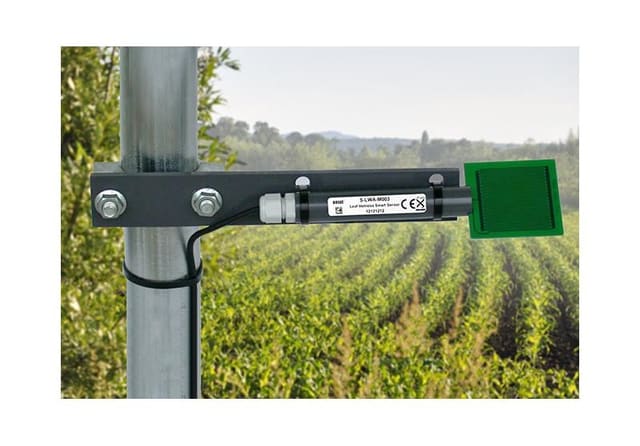
LI-COR (HOBO, InTemp, LI-COR) · S-LWA-M003
Leaf Wetness Smart Sensor
The Leaf Wetness Smart Sensor provides accurate leaf wetness data in a number of growing and research applications. The sensor is ready to use and does not require any painting or coating. It uses a capacitive grid that is less sensitive to surface residues…
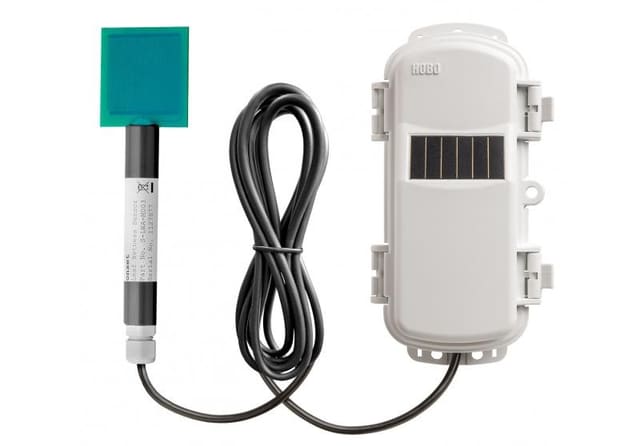
LI-COR (HOBO, InTemp, LI-COR) · RXW-LWA-868
Leaf Wetness Sensor
The HOBOnet Leaf Wetness Sensor provides accurate leaf wetness data for a variety of growing and research applications. The sensor is ready to use and does not require any painting or coating. It uses a capacitive grid that is less sensitive to surface…
Keep reading
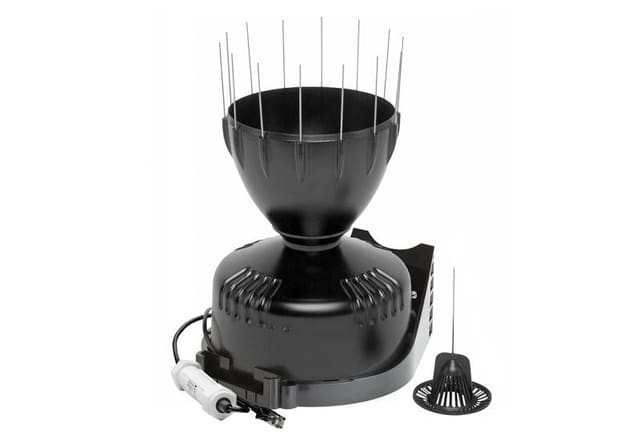
When it rains hardest, it misses most: height, calibration and maintenance of tipping-bucket rain gauges
A tipping-bucket rain gauge loses rain to wind and to its own mechanics, and the second loss grows with intensity. What four peer-reviewed studies say about installation height, dynamic calibration and maintenance.
Why two identical sensors do not read the same: choosing a radiation shield
The shield around the sensor can contribute more error than the sensor itself. What two peer-reviewed studies say about natural ventilation and forced aspiration, and what to document so the series is usable.
How long does biofouling take to spoil a conductivity record? What a study with moored sensors in the Baltic measured
In a study off the southern Baltic coast, a conductivity sensor moored at 2 m with a used TBT cell was out of specification at the first comparison after deployment, on day 32; with a UVC emitter, the last references, after 237 days, were within the margin. What this changes when planning visits and references.