
Data logging · Weather monitoring
Week in review, 5 to 9 October 2026: what the thermometer does not see
The week's four pieces, three of them on what the thermometer does not measure, three European signals with their sources, and what is coming: the Environment Council on 12 October, the September summaries still to be published and the end of summer time on 25 October.
If your station logs only air temperature, the blog gave you three reasons this week to look beyond the thermometer. Here is what we published, what happened in Europe and what is coming.
What we published this week
Week of 5 to 11 October: official signals for an unsettled week and what to check in your own rainfall record, with the 2025-2026 hydrological year closing 2% above normal.
PAR or global solar radiation?: they are not the same quantity and are not measured with the same sensor, and the factor that converts one into the other changes with the sky.
Record heat stress in summer 2026: the index Copernicus uses combines four variables, and a station that logs only air temperature provides one of them.
Is temperature enough to estimate ET0?: at 45 stations in Aragón, ET0 calculated from temperature alone rose at 36, Penman-Monteith ET0 rose significantly at none, and mean wind speed fell at 34.
The common thread in the last three: what needs measuring besides air temperature, from radiation to wind.
Three signals from Europe
IPMA closes September in mainland Portugal. In the summaries of its climate bulletins, published on 7 October 2026: "Setembro de 2026 foi extremamente quente e muito seco em Portugal Continental" (September 2026 was extremely hot and very dry in mainland Portugal). Why it matters: it is the official context for reading September in your own series; a large gap does not prove an error, but it is a reason to check the radiation shield and the rain gauge before closing the month.
The Commission assesses the water plans of Portugal and seven other countries. On 5 October 2026 the European Commission published its assessments of the third River Basin Management Plans and the second Flood Risk Management Plans of Bulgaria, Cyprus, Greece, Ireland, Malta, Portugal, Slovakia and Slovenia, which had not provided data in time for the reports of February 2025. The reports highlight "insufficient monitoring and lack of ambition and funding". Source: European Commission. Why it matters: the Commission itself lists the lack of monitoring among the problems facing water; the news item links to each country's assessment.
Copernicus launches its report on ozone, smoke and dust. On 30 September 2026 the Copernicus Atmosphere Monitoring Service (CAMS) published its first Atmosphere Watch report. According to ECMWF, half of Europe's population was exposed this year to "Poor", "Very Poor" or "Extremely Poor" ozone, with repeated heatwaves among the causes; the report also tracks smoke from large fires, including in Spain, and Saharan dust. Source: ECMWF. Why it matters: a World Health Organization official, quoted in the news item, says these data help "fill the gaps between monitoring stations"; the model completes the map, but the value at your point comes from a measurement at that point.
What is coming
Monday 12 October: EU Environment Council in Luxembourg. Ministers will debate the review of the Emissions Trading System and are invited to approve conclusions for COP31, from 9 to 20 November in Antalya (Türkiye). Source: Council of the EU.
September summaries still to come. At the time of consultation, neither AEMET nor the Copernicus Climate Change Service (C3S) had published its September summary; the August ones came out on 8 and 10 September respectively, and no date has been announced. Sources: AEMET and C3S.
Further ahead, Sunday 25 October: summer time ends. Directive 2000/84/EC sets the end at 1.00 a.m. Greenwich Mean Time on the last Sunday in October. Before that night, check whether your logger stores local time or UTC and record it in the series metadata, so that the clock change is not mistaken for a feature of the data. Source: EUR-Lex.
Commercial selection by EIC Controls
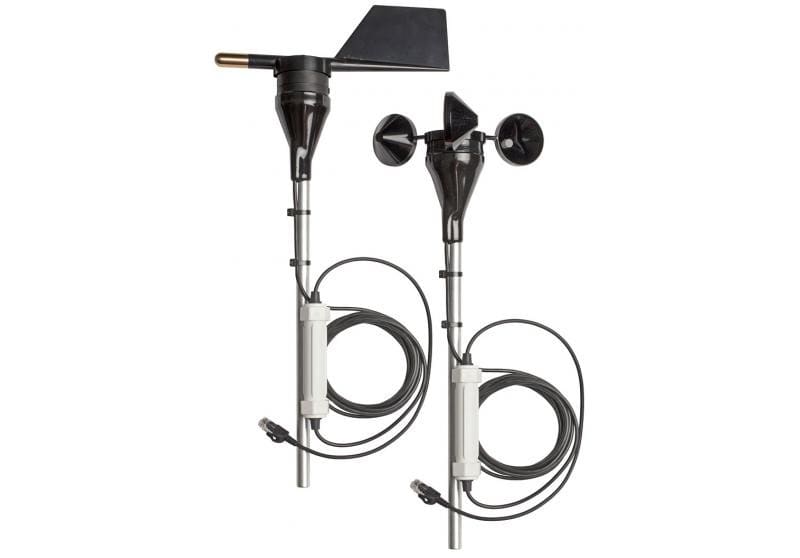
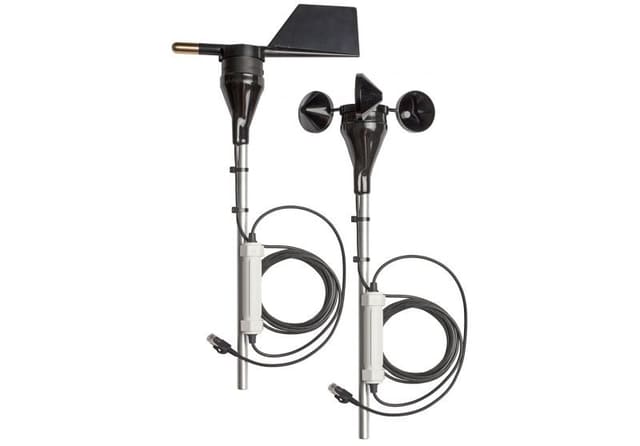
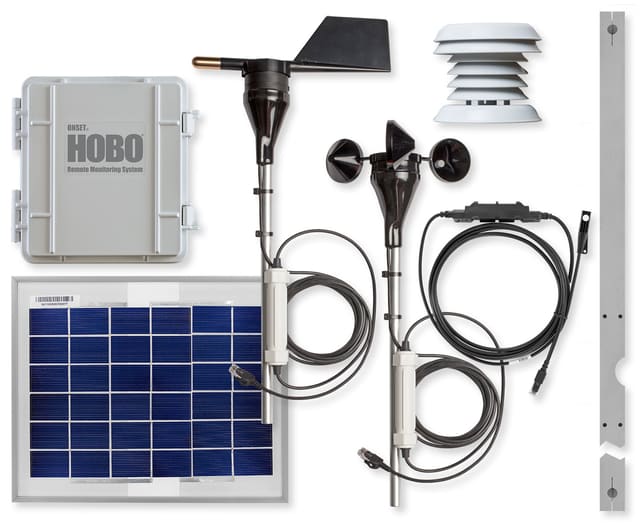
According to its datasheet, the S-WSET-B wind sensor set combines a wind speed smart sensor and a wind direction smart sensor, and gives the average wind speed, the highest 3-second gust and the average direction for each logging interval. We feature it this week because wind was one of the variables required by both the heat stress index and Penman-Monteith ET0. Still to be sized: the weather station logger it connects to, the full cross arm and the stable mast the datasheet recommends (with guy wires if needed), and the mounting height, which is worth recording.
View datasheet · Talk to a specialist
References
- Instituto Português do Mar e da Atmosfera (2026). "Boletins Climatológicos de Setembro". ipma.pt. Accessed 09/10/2026, around 06:50 (Madrid time).
- European Commission, Directorate-General for Environment (2026). "New EU source-to-sea assessments for certain Member States underline need for stronger action on pollution and resilience". environment.ec.europa.eu. Accessed 09/10/2026, around 06:50 (Madrid time).
- ECMWF (2026). "New Copernicus publication highlights transboundary nature of ozone pollution, wildfire smoke and desert dust". ecmwf.int. Accessed 09/10/2026, around 06:50 (Madrid time).
- Council of the European Union (2026). "Environment Council, 12 October 2026". consilium.europa.eu. Accessed 09/10/2026, around 06:50 (Madrid time).
- AEMET. "Noticias" (news listing). aemet.es. Accessed 09/10/2026, around 06:50 (Madrid time).
- Copernicus Climate Change Service. "Climate Bulletins". climate.copernicus.eu. Accessed 09/10/2026, around 06:50 (Madrid time).
- European Parliament and Council (2001). "Directive 2000/84/EC of the European Parliament and of the Council of 19 January 2001 on summer-time arrangements". eur-lex.europa.eu. Accessed 09/10/2026, around 06:50 (Madrid time).
Instruments for this application
LI-COR (HOBO, InTemp, LI-COR) · S-WSET-B
Wind Speed and Direction Set Smart Sensor
The Wind Sensor Set includes Onset's research-grade plug-and-play Wind Speed Smart Sensor and the Wind Direction Smart Sensor. This combination provides average wind speed, highest 3-second wind gust, and average wind direction for the measurement interval.…
Keep reading
Changing site or instrument without breaking the record: lessons from the Montseny summit series (1950-2025)
On 31 October 2026 AEMET and the SMC published an analysis of the Montseny summit series, which joins two sites and fills the gaps from 2001 to 2010. What it teaches anyone planning to move a station or change a sensor.
The Commission proposes a common warming trajectory for climate risk assessments: what to measure at your site to read it
On 27 October 2026 the European Commission proposed the European Climate Resilience Law, with a reference global warming trajectory and periodic risk assessments. What that information describes, what it does not describe about your site and what is worth recording.
Week in review, 19 to 23 October 2026: from the 9 km grid to your plot
The week's four pieces (water level, frost, the warmest September and dendrometers), three European signals with their sources (ECMWF's open 9 km data, AEMET's analysis of the Catalonia rainfall and drought according to the JRC) and what is coming: the end of summer time on the 25th and the MARS Bulletin on the 26th.